If you’ve paused over laid out or layed out, you’re not alone. This pair confuses students, writers, professionals, and everyday English speakers because lay, laid, lay out, past tense, phrasal verb, and usage all overlap in a tricky way. The good news is that the rule is simple once you see the pattern: in standard American English, laid out is the correct form, while layed out is an error.
This guide breaks down the answer, shows what laid out means in real sentences, and helps you avoid nearby mistakes like lay out vs. layout and lay vs. lie. By the end, you’ll know which form to use and why.
Quick Answer
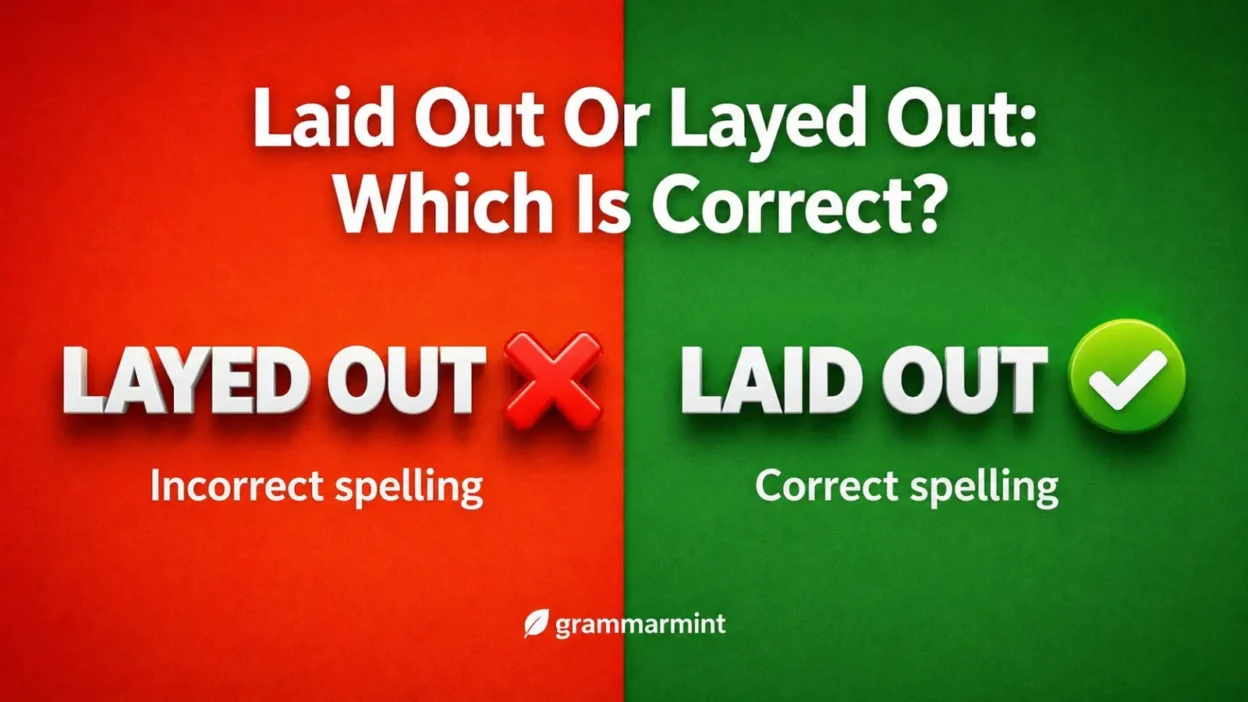
Laid out or layed out: the correct form is laid out. Layed out is not standard English because the past tense and past participle of lay are laid, not layed.
TL;DR
• Laid out is correct
• Layed out is a misspelling
• Lay becomes laid in past forms
• Laid out has several meanings
• Lay and lie often cause confusion
• Layout is a different word
Laid Out Or Layed Out
The correct choice is laid out in standard written English. That rule holds in American and British usage because laid is the accepted past form of lay.
• She laid out the clothes early
• He laid out the plan clearly
• They laid out the tools neatly
• We laid out every option
• The teacher laid out the rules
• She laid out the papers fast
• They laid out lunch outside
• He laid out the design first
• We laid out the budget carefully
• She laid out the roadmap yesterday
• They laid out the evidence calmly
• He laid out each step simply
Quick Grammar Rule
A fast way to edit this phrase is to check the base verb. If the base verb is lay, the past form is laid, so the correct phrase becomes laid out.
• Present: I lay out the files
• Past: I laid out the files
• Perfect: I have laid out notes
• Passive: The pages were laid out
• Never write layed out here
• Use laid after past-time markers
• Use laid in finished actions
• Use laid in polished writing
• Use laid in school work
• Use laid in business emails
• Use laid in captions too
• Use laid in edited drafts
The Verb Pattern Behind The Answer
The pattern is simple once you memorize it: lay – laid – laid. In other words, lay does not form its past tense with a plain -ed spelling the way many regular verbs do.
• Base verb: lay
• Simple past: laid
• Past participle: laid
• Present participle: laying
• Not standard: layed
• Phrase base: lay out
• Past phrase: laid out
• Perfect phrase: have laid out
• Passive phrase: was laid out
• Same rule in formal writing
• Same rule in casual writing
• Same rule in edited speech
Why “Layed Out” Looks Tempting
People often write layed out because English trains us to expect many verbs to add -ed in the past. That instinct feels natural, but lay follows the laid pattern instead.
• It looks regular at first
• It sounds close in speech
• Many verbs add -ed
• Spellcheck may be missed
• Fast typing causes the slip
• The lay/lie pair adds confusion
• Writers trust what sounds familiar
• Learners overapply regular patterns
• The error spreads online
• It appears in rough drafts
• It survives in casual posts
• Editing usually catches it
What “Laid Out” Means
Laid out can mean several things depending on context. Most often, it means arranged, displayed, or explained, but it can also refer to money spent or, informally, someone knocked flat.
• arranged on a surface
• displayed for others to see
• explained step by step
• presented in clear order
• planned in advance
• spread neatly across space
• spent, especially money
• placed carefully beforehand
• organized for easy review
• set out for use
• stretched out informally
• knocked down informally
Common Ways To Use “Laid Out”
You’ll often see laid out in home, school, and work writing because it fits many everyday situations. It works especially well when something is prepared, shown, or explained clearly.
• She laid out breakfast early
• He laid out the schedule
• They laid out the agenda
• We laid out the samples
• She laid out three choices
• He laid out the instructions
• They laid out fresh towels
• We laid out the seating chart
• She laid out the evidence
• He laid out the terms
• They laid out the strategy
• We laid out the timeline
“Laid Out” For Plans And Ideas
In professional and academic writing, laid out often means outlined, presented, or clearly stated. It suggests that ideas were organized so other people could follow them easily.
• She laid out her proposal well
• He laid out the next steps
• They laid out the goals first
• We laid out every assumption
• She laid out the argument
• He laid out the case calmly
• They laid out the findings
• We laid out the process simply
• She laid out the vision
• He laid out the concerns
• They laid out the policy change
• We laid out the recommendations
“Laid Out” For Money
Another common meaning is money that was spent or paid out. This sense appears more often in informal writing, finance talk, and everyday conversation.
• We laid out a lot cash
• She laid out extra fees
• He laid out money upfront
• They laid out funds quickly
• We laid out too much
• She laid out rent early
• He laid out the deposit
• They laid out travel costs
• We laid out repair money
• She laid out a fortune
• He laid out the full amount
• They laid out every dollar
Informal Meaning Of “Laid Out”
In casual English, laid out can also mean someone was knocked out, flattened, or left stretched out after impact, illness, or exhaustion. This is informal, so tone matters.
• The punch laid out him
• Flu laid out half the team
• Heat laid out everyone indoors
• The hit laid out the boxer
• Stress nearly laid out me
• That workout laid out him
• Migraine laid out her all day
• The cold laid out staffers
• Jet lag laid out me
• The fall laid out him
• Food poisoning laid out them
• Allergy season laid out her
Lay, Lie, And “Laid Out”
This is where many writers get tripped up. Lay usually takes an object, while lie does not, and their past forms cross in a way that sounds confusing: lay → laid, but lie → lay.
• I lay the book down
• Yesterday, I laid it down
• I lie on the couch
• Yesterday, I lay there
• I have lain there before
• She laid out the folder
• She did not layed out it
• The cat lay by the door
• He laid the keys here
• Lay needs an object
• Lie does not need one
• That difference prevents many errors
Everyday Sentence Examples
Real examples make this easier to remember. Once you hear laid out in natural settings, the wrong version starts to look off immediately.
• Mom laid out snacks before guests
• The nurse laid out supplies first
• My boss laid out expectations clearly
• We laid out maps on the table
• The coach laid out practice rules
• She laid out clothes for tomorrow
• Dad laid out the tools neatly
• They laid out chairs in rows
• The guide laid out our route
• He laid out the payment plan
• The editor laid out revisions kindly
• Our teacher laid out the assignment
“Lay Out” Vs. “Layout”
These forms are related, but they are not the same word. Lay out is a verb phrase, while layout is usually a noun referring to a design, arrangement, or page structure.
• Verb: lay out the pages
• Past verb: laid out the pages
• Noun: the page layout looks clean
• Verb phrase uses two words
• Noun usually uses one word
• Don’t swap them casually
• “We laid out the room” works
• “The room layout works” too
• Verbs show action clearly
• Nouns name the arrangement
• Context tells which one fits
• Spacing changes the meaning
Synonyms That Fit “Laid Out”
Sometimes a different verb can make your sentence sharper. Depending on context, you might prefer arranged, outlined, spread out, or presented instead.
• arranged
• displayed
• spread out
• presented
• outlined
• explained
• organized
• positioned
• mapped out
• set out
• disbursed
• paid out
Similar Mistakes To Avoid
Once you know laid out is correct, you can spot nearby errors faster. The same rule helps with phrases like laid off and laid down, where writers sometimes wrongly use layed.
• laid off, not layed off
• laid down, not layed down
• laid bare, not layed bare
• laid aside, not layed aside
• laid open, not layed open
• laid low, not layed low
• laid back is separate usage
• lay down can be correct too
• Tense decides the right form
• Objects still matter here
• Context changes the verb choice
• Read the whole sentence aloud
Easy Memory Tricks
A small memory trick can save you time when editing. Think of the pattern lay, laid, laid and connect laid out with other familiar forms like laid off and laid down.
• Think: lay → laid → laid
• Keep the i in laid
• Pair it with laid off
• Pair it with laid down
• Check for a finished action
• Check whether an object appears
• Replace it with arranged
• Replace it with outlined
• Read the sentence twice
• Trust the verb pattern
• Ignore the tempting -ed
• Save a personal example
When To Choose A Different Verb
Sometimes laid out is correct, but not best. If you mean someone reclined, lay or lain may fit better, and if you mean “explain,” a verb like outline may sound cleaner.
• Use lay for placing something
• Use laid for past placing
• Use lie for reclining
• Use lay for past reclining
• Use lain in formal perfect forms
• Use outline for formal clarity
• Use arrange for physical order
• Use display for visual setup
• Use spread out for surfaces
• Use pay out for funds
• Use set out for listing
• Use precise verbs when possible
FAQs
Is it “laid out” or “layed out”?
Use laid out. Standard dictionaries and grammar references treat laid as the past tense and past participle of lay, so layed out is not the standard form.
Is “layed out” ever correct?
In standard modern English, no. You may see it in mistakes, rough drafts, or nonstandard writing, but edited usage favors laid out.
What does “laid out” mean?
It can mean arranged on a surface, presented clearly, explained step by step, or money spent. In informal use, it can also mean knocked flat or exhausted.
Why is this phrase so confusing?
The biggest reason is the overlap between lay and lie. Lay becomes laid, but lie becomes lay in the simple past, so the forms sound close and create mix-ups.
What is the difference between “lay out” and “layout”?
Lay out is a verb phrase meaning to arrange, present, or explain. Layout is usually a noun that names a design or arrangement.
Can I use “laid out” in professional writing?
Yes. It works well when you mean that someone presented information, explained steps, or arranged materials clearly.
Conclusion
If you’re choosing between laid out or layed out, go with laid out. That’s the standard form, and once you remember lay → laid → laid, the choice gets much easier.