If you want a simple answer to less than or greater than, this guide is for you. These math symbols help you compare numbers, read inequalities, and decide which value is smaller, larger, or equal. You’ll see them in homework, worksheets, quizzes, word problems, and early algebra. Because the signs look alike, many learners mix them up at first. Still, once you understand where the open side points and how the values compare, the idea gets much easier. This guide walks you through the meanings, memory tricks, examples, and practice tips in plain American English.
Quick Answer
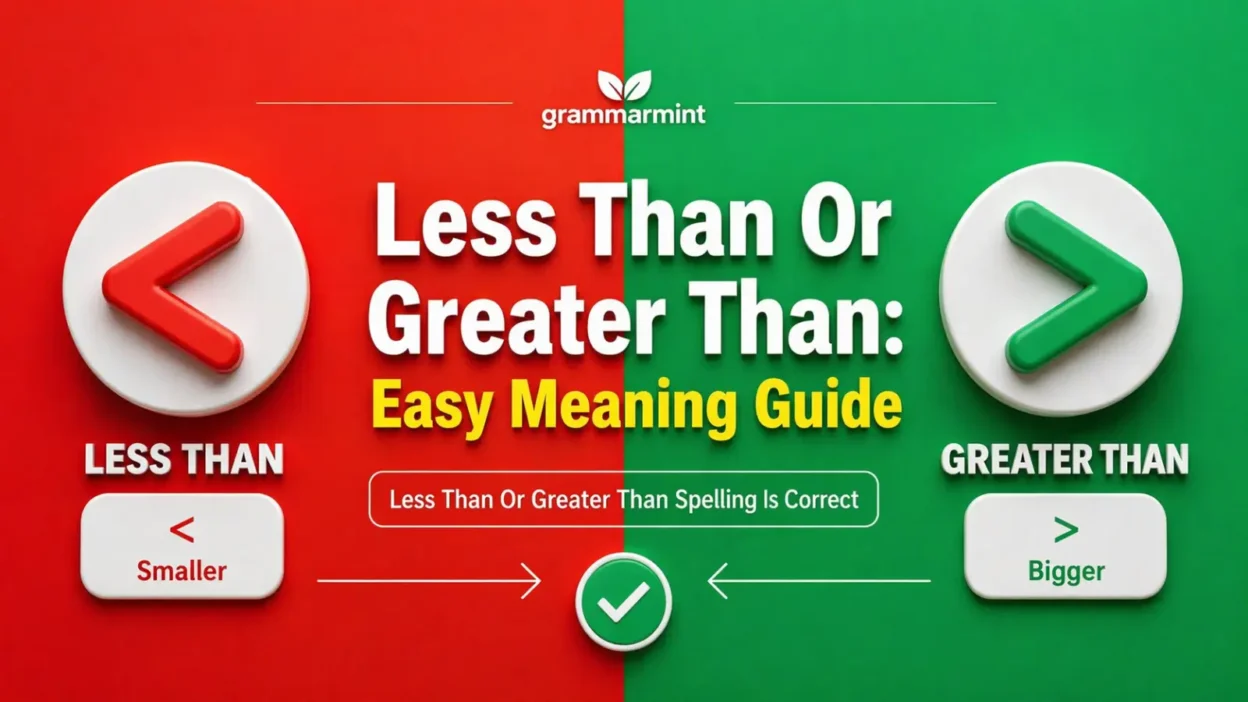
Less than or greater than means comparing two values to show which one is smaller or larger. Use < when the number on the left is smaller, and use > when the number on the left is larger.
TL;DR
• < means the left value is smaller
• > means the left value is bigger
• The open side faces the larger value
• Start by comparing the left side first
• Decimals and fractions need extra care
• Negative numbers can feel backward at first
What Less Than Or Greater Than Means
These signs show a relationship between two values. In other words, they tell you whether one number is smaller or larger than another.
You’ll usually see them in early math, number comparison, and beginner algebra. Once you know the pattern, reading them becomes much faster.
• Compare numbers by looking at both sides
• Math symbols show size, not operation
• Smaller or larger is the main idea
• One sign opens left, one opens right
• They help compare values quickly
• They don’t mean add or subtract
• They can compare numbers or expressions
• They’re used before algebra too
• They work with whole numbers
• They also work with decimals
• Fractions can use them too
• Negative numbers follow the same rules
What The Less Than Sign Means
The less than sign is <. It tells you the value on the left is smaller than the value on the right.
So, when you read 3 < 8, you say, “3 is less than 8.” The sign points toward the smaller side.
• Less than symbol is written as <
• Smaller than is the key meaning
• Points to the smaller value
• 2 < 5 is true
• 9 < 4 is false
• Read left side first
• Say “is less than” aloud
• Use it for lower amounts
• Use it for smaller counts
• It compares two quantities
• The open side faces bigger value
• The narrow point faces smaller value
What The Greater Than Sign Means
The greater than sign is >. It tells you the value on the left is larger than the value on the right.
For example, 10 > 6 means “10 is greater than 6.” Here, the wider open side faces 10 because 10 is larger.
• Greater than symbol is written as >
• Larger than is the key meaning
• Open side faces the bigger value
• 7 > 3 is true
• 1 > 9 is false
• Read it left to right
• Say “is greater than” aloud
• Use it for higher amounts
• Use it for bigger counts
• It compares size clearly
• The point faces smaller value
• The open side welcomes the larger number
How Comparison Symbols Work
These signs compare what is on the left with what is on the right. So, the first step is always to look at the left value and then match it against the right value.
If the left side is bigger, use >. If the left side is smaller, use <.
• Compare values on both sides first
• Left side matters in every statement
• Right side is the value compared against
• 6 > 4 because left is bigger
• 4 < 6 because left is smaller
• Same numbers need an equal sign
• Check the value, not the shape
• Bigger side gets the open mouth
• Smaller side gets the point
• Read each statement as words
• Turn examples into spoken sentences
• Practice with simple pairs first
Easy Examples You Can Read Fast
Examples help the symbols make sense quickly. Start with easy number pairs before moving to decimals or fractions.
Also, say each one out loud. That habit helps many learners remember the sign and the meaning together.
• Simple examples build confidence fast
• Number pairs make the pattern clear
• Quick practice works best daily
• 1 < 4
• 9 > 2
• 15 > 11
• 7 < 12
• 20 > 19
• 30 < 31
• 100 > 10
• 0 < 5
• 8 = 8 needs equals instead
Tricks To Remember The Signs
Memory tricks can help, especially at the start. Still, it’s best to learn both the trick and the reason behind it.
The most common trick says the open side faces the larger number. Another popular one is the alligator image, where the mouth wants the bigger value.
• Alligator method is common in schools
• Open mouth faces the bigger value
• L trick helps with less than
• < can resemble an L shape
• Greater than is the other sign
• Think “wide side, bigger number”
• Think “pointy side, smaller number”
• Say the sentence aloud too
• Don’t depend on one trick forever
• Learn the actual meaning early
• Visuals help younger learners most
• Reason plus trick works best
Teaching Kids Without Confusing Them
Kids usually learn these signs during early number comparison. Because the symbols look similar, short routines and clear visuals help a lot.
Use objects, spoken sentences, and simple number cards. That way, the child learns the idea, not just the shape.
• For kids keep the language simple
• Visual learning helps the idea stick
• Number sense matters more than tricks
• Use blocks before symbols
• Compare groups of objects first
• Start with small whole numbers
• Ask which side has more
• Then add the correct sign
• Use cards for quick matches
• Read every answer aloud
• Keep examples short and clear
• Review often with mixed pairs
Comparing Bigger Numbers
Bigger whole numbers need place value. First compare the number of digits, and if that matches, compare from the leftmost digit.
This method makes large comparisons much easier. It also stops random guessing.
• Place value decides many comparisons
• Digit count comes first
• Compare whole numbers left to right
• 345 > 298
• 1,002 > 999
• 4,120 < 4,210
• More digits usually means bigger
• Same digits need closer checking
• Start with the greatest place
• Move right only if tied
• Don’t compare final digits first
• Commas don’t change the value
Comparing Decimals
Decimals can look tricky, but the rule is still comparison by place value. Line up the decimal points, then compare tenths, hundredths, and so on.
Adding a zero at the end can also help. For example, 0.5 and 0.50 are equal.
• Tenths come right after the decimal
• Hundredths come after tenths
• Line up place values carefully
• 0.7 > 0.3
• 1.25 < 1.5
• 0.40 = 0.4
• Compare whole-number parts first
• Then compare decimal places
• Add zeros when helpful
• Don’t compare digit count alone
• 0.09 < 0.9
• Read decimals slowly at first
Comparing Fractions
Fractions need a little more strategy. Sometimes you can compare by sight, but often you need common denominators or benchmark fractions.
For example, 1/2 is greater than 1/4 because half is more than a quarter. And 3/4 is greater than 2/3 after closer comparison.
• Common denominator makes comparison easier
• Benchmark fractions help you estimate
• Fraction size depends on both numbers
• 1/2 > 1/4
• 2/5 < 3/5
• Same denominator compares numerators
• Same numerator compares denominators carefully
• Larger pieces mean smaller denominator
• Use drawings for beginners
• Convert when needed
• Cross-check tricky pairs
• Don’t judge by numerator alone
Comparing Negative Numbers
Negative numbers often confuse learners because the bigger-looking digit may actually represent a smaller value. On a number line, values farther left are smaller.
So, -8 is less than -3 because -8 sits farther left. And 0 is greater than any negative number.
• Negative numbers can feel backward first
• Number line thinking helps a lot
• Farther left means smaller value
• -8 < -3
• -2 > -7
• 0 > -1
• Any positive beats any negative
• Closer to zero is greater
• Compare location, not just digits
• Draw a number line
• Read signs carefully
• Pause before answering quickly
Less Than Or Equal To And Greater Than Or Equal To
Sometimes two values can be equal as well as smaller or larger. That is where ≤ and ≥ come in.
Use ≤ for “less than or equal to.” Use ≥ for “greater than or equal to.” These show that equality is still allowed.
• ≤ means less than or equal to
• ≥ means greater than or equal to
• At least / at most often signal these
• x ≤ 10 includes 10
• x ≥ 5 includes 5
• They allow equality too
• They appear in word problems
• They’re common in algebra
• Read them slowly at first
• Watch for “no more than”
• Watch for “at least”
• Don’t replace them with < or >
From Symbols To Inequalities
Once symbols start comparing expressions with variables, you move into inequalities. The idea is still comparison, but now the answer may be a range of values.
For example, x > 4 means any number greater than 4 works. So, 5 works, 10 works, and 4 does not.
• Inequality compares values that may vary
• Variable stands for an unknown value
• Solution set includes many answers sometimes
• x < 3 means numbers below 3
• y > 8 means values above 8
• x ≥ 2 includes 2
• x ≤ 9 includes 9
• Number lines show solutions well
• Open circles exclude endpoints
• Closed circles include endpoints
• Test values to check
• Keep the comparison meaning clear
Ordering Numbers From Least To Greatest
Ordering is just repeated comparison. To go from least to greatest, put the smallest value first and the largest last.
Likewise, greatest to least reverses the order. This skill shows up in classwork, charts, and quick quizzes.
• Ascending order means least to greatest
• Descending order means greatest to least
• Sort numbers by comparing pairs
• Start with the smallest value
• End with the largest value
• Use place value for speed
• Decimals need aligned thinking
• Fractions may need conversion
• Negatives belong farther left
• Check ties carefully
• Rewrite the full list neatly
• Re-read the order once finished
Practice Ideas For Home And Class
Practice does not need to be long. In fact, a few focused examples each day often work better than one huge set.
Mix spoken reading, written comparison, and quick games. That keeps the skill from feeling too repetitive.
• Worksheets help with steady repetition
• Flash cards make fast review easy
• Math games keep practice light
• Compare grocery prices together
• Use dice for number pairs
• Write true or false statements
• Fix wrong comparisons aloud
• Sort cards from least to greatest
• Try timed mini rounds
• Use a small whiteboard
• Practice decimals on later days
• Review mistakes the next day
Common Mistakes And Quick Fixes
Most mistakes happen because the signs look alike or the learner rushes. Fortunately, a short check can catch many errors before you move on.
Read the comparison aloud. Then ask whether the sentence sounds true.
• Common errors happen when students rush
• Symbol flip is the top mistake
• Double-check by reading aloud
• Don’t memorize shape without meaning
• Compare values, not appearances
• Bigger digit count matters first
• Decimals need aligned place values
• Fractions need common sense and method
• Negatives are smaller farther left
• Equal numbers need = instead
• Recheck the left side first
• Turn each sign into words
FAQs
What is the difference between less than and greater than?
Less than shows the value on the left is smaller than the value on the right. Greater than shows the value on the left is larger than the value on the right.
How do you remember less than and greater than symbols?
A helpful reminder is that the open side faces the bigger number. You can also remember that the less than sign, <, can look a bit like the letter L.
What does < mean in math?
The symbol < means “is less than.” So, in 4 < 9, the number 4 is smaller than 9.
What does > mean in math?
The symbol > means “is greater than.” So, in 12 > 7, the number 12 is larger than 7.
Which side does the less than sign point to?
The narrow point faces the smaller value. Meanwhile, the open side faces the larger value.
When do you flip an inequality sign?
You flip the sign when multiplying or dividing both sides of an inequality by a negative number. For example, if x < 5, then -x > -5.
What do ≤ and ≥ mean?
≤ means less than or equal to, and ≥ means greater than or equal to. These signs include the endpoint, so equality is allowed.
Conclusion
Less than or greater than gets much easier once you focus on the meaning, not just the shape.
Start with simple number pairs, read each comparison out loud, and then move to decimals, fractions, and inequalities with confidence.