Affend or offend can trip up students, writers, and everyday readers who want clear American English. Maybe you saw the word in a text, a caption, a school paper, or a work message and paused. That happens because correct spelling, standard English, misspelling, pronunciation, apology wording, and related forms like offended and offense all sit close together. This guide clears it up fast. It also shows what offend means, how to use it in sentences, when related forms fit, and how to avoid common mix-ups in real writing.
Quick Answer
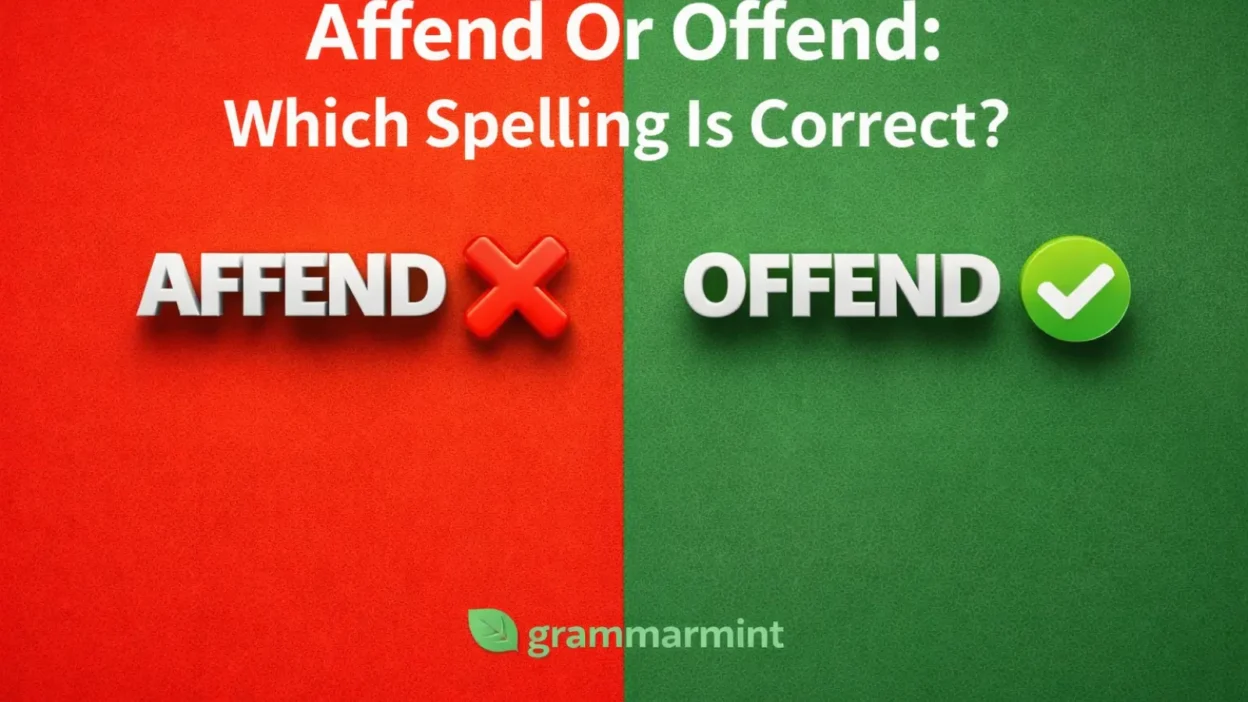
Affend or offend: offend is the correct spelling. Affend is not standard English and is treated as a misspelling in American writing.
TL;DR
• Use offend, not affend
• Affend is a misspelling
• Offend is a verb
• Offended describes someone’s reaction
• Offensive describes something hurtful
• Offense is the usual US noun
Affend Or Offend
You only need one choice in standard American English. Use offend every time.
The confusion is common, though. Even so, the fix is simple once you see the pattern.
• Correct spelling is offend in standard English
• Standard English does not accept affend
• Misspelling alerts often flag affend immediately
• Offend works in school and work writing
• Affend looks careless in edited copy
• Offend appears in dictionaries and examples
• Affend usually shows up as a typo
• Use offend in formal messages
• Use offend in casual messages too
• Readers recognize offend right away
• Spellcheck usually catches affend fast
• Choose offend when clarity matters
Is Affend A Real Word
This is the question many readers actually want answered. The short answer is no.
In modern American writing, affend is not the accepted form. It is best treated as a spelling mistake.
• Nonword is the safest label here
• Typo is how affend usually appears
• Accepted form is offend, not affend
• Affend is not standard classroom English
• Affend is not standard business English
• Most dictionaries do not list affend
• Writers usually mean offend instead
• Affend can distract careful readers
• It weakens polished writing quickly
• It can confuse English learners
• It is not the preferred variant
• Replace affend with offend every time
What Does Offend Mean
Now let’s get to meaning. Offend usually means to upset, annoy, or hurt someone by words or actions.
However, it can also mean breaking a rule, law, or accepted standard in more formal contexts.
• Upset someone through words or behavior
• Insult someone directly or indirectly
• Show disrespect through tone or conduct
• Hurt feelings without planning to
• Cause resentment with a remark
• Cross a social line
• Break a rule in formal use
• Violate a law in legal use
• Clash with someone’s values
• Seem rude to listeners
• Sound harsh in context
• Trigger a negative reaction
How Do You Spell Offend
The spelling is easier when you connect it to the sound. Most Americans say it like “uh-FEND.”
That second syllable often pulls attention away from the first letter. So, some writers guess wrong and type affend.
• Pronunciation often sounds like uh-FEND
• Use this memory trick: start with “of”
• Hear the second-syllable stress clearly
• Think of offense and offender
• Keep the double f in place
• End the word with -end
• Start with o, not a
• Say it slowly while typing
• Link it to “offense” in US English
• Check spelling before sending messages
• Copy the correct form once
• Practice offend in short sentences
Offend Definition At A Glance
It helps to see the word as a working verb. That keeps the grammar clear.
Usually, offend is the action. A person offends, and someone else feels offended.
• Verb form shows the action
• Main emotional sense means hurt feelings
• A legal sense appears in formal use
• Offend can be transitive
• It can appear without intent
• It often involves tone
• It may involve manners
• It can refer to taste
• It can refer to law
• It fits apology language well
• It belongs in everyday English
• It stays common across contexts
Offend In A Sentence
Examples make spelling stick faster. They also show tone.
Here are simple patterns you can borrow in real life.
• Casual writing: I didn’t mean to offend you
• School writing: The joke may offend some readers
• Workplace writing: We don’t want to offend clients
• Her comment could offend the group
• That post might offend some followers
• He spoke carefully to avoid offend mistakes
• The ad could offend viewers
• Please don’t offend your host tonight
• I hope this question doesn’t offend you
• The wording may offend older readers
• They apologized after they offend? No—offended
• Use offend before the person affected
What Does Offended Mean
Offended is different from offend. It usually describes the feeling after the action.
So, if someone says, “I was offended,” they are talking about their reaction.
• Adjective use describes a person’s state
• It refers to feelings after something happened
• It shows a reaction, not the action
• I felt offended by that joke
• She seemed offended by the tone
• He looked offended after the comment
• Many readers were offended online
• Don’t use offended for the verb base
• Offended often follows “feel” or “seem”
• It can describe mild hurt
• It can describe strong anger
• Context shows the intensity
Offended Vs Offensive
These two forms sit near each other, but they do different jobs. That’s why writers mix them up.
Offended describes a person’s reaction. Offensive describes the thing that caused it.
• Adjective contrast matters here
• Description belongs to offensive
• Reaction belongs to offended
• She was offended by the meme
• The meme was offensive to her
• He sounded offended, not offensive
• That phrase felt offensive in context
• Offended describes people most often
• Offensive describes words or actions
• Don’t swap the two forms
• The ending changes the meaning
• Check the sentence subject first
Offend Vs Insult
These words overlap, but they are not exact twins. That difference matters in tone.
Usually, insult feels more direct and stronger. Offend can be softer and sometimes accidental.
• Intention is often clearer with insult
• Tone is usually harsher with insult
• Stronger word is often insult
• Offend can be unplanned
• Insult sounds more deliberate
• Offend may involve sensitivity
• Insult often targets dignity directly
• Offend can be broad
• Insult is usually personal
• Both can hurt feelings
• Choose offend for softer wording
• Choose insult for direct disrespect
How To Pronounce Offend
Good pronunciation can support good spelling. It helps your ear guide your fingers.
In American English, the stress falls on the second part. That’s why “uh-FEND” is a useful memory cue.
• Say uh-FEND in everyday speech
• Hear the stress on the second syllable
• Use spoken English to support spelling
• Start softly with the first sound
• Keep the ending crisp
• Avoid adding an a sound first
• Repeat offend three times aloud
• Match spelling to the sound
• Listen for the double f
• Practice with offense and offender
• Short words still need stress
• Reading aloud improves recall
Offense Vs Offence
This is where many readers turn next. The verb stays offend, but the noun changes by region.
In the United States, the standard noun is offense. In British English, offence is common.
• American English prefers offense
• British English often prefers offence
• Noun form changes, not the verb
• Offend stays the same in both
• Use offense in US writing
• Use offence in many UK texts
• Take offense is US style
• Take offence is UK style
• Check your audience first
• Keep one style throughout
• Don’t mix spellings randomly
• The meaning stays the same
What Does Take Offense Mean
This phrase is common in conversation. It focuses on the listener’s reaction.
When someone takes offense, they feel hurt, bothered, or disrespected by something said or done.
• Take offense means feel hurt or bothered
• It shows sensitivity to words or actions
• Context decides whether it seems reasonable
• She took offense at the joke
• He took offense to the comment
• The phrase is common in speech
• It centers the listener’s response
• It doesn’t prove bad intent
• Tone changes how it lands
• Audience matters a lot
• Public remarks raise the risk
• Gentle wording lowers tension
What Does No Offense Mean
This phrase tries to soften what comes next. Still, it often fails.
In real life, “no offense” can sound polite, defensive, or sarcastic, depending on the tone.
• No offense tries to soften criticism
• Softener does not erase rude wording
• Sarcasm risk is high in some contexts
• It may sound dismissive
• It can feel passive-aggressive
• It works poorly before insults
• Tone decides the effect
• Friends may read it lightly
• Coworkers may read it harshly
• Skip it in formal emails
• Rewrite with direct kindness instead
• Use clear respect, not a warning
Didn’t Mean To Offend
This is one of the most useful real-world patterns. It helps repair a conversation fast.
Still, the best apology does more than mention intent. It also shows care.
• Apology language should stay simple
• Intent matters, but impact matters too
• Repair starts with clear ownership
• I didn’t mean to offend you
• I’m sorry my words landed badly
• Thanks for telling me that
• I can see why that hurt
• I’ll phrase it better next time
• I wasn’t trying to be rude
• I appreciate the correction
• Let me say that differently
• A calm apology works best
Synonyms For Offend
Synonyms can help, but they are not perfect swaps. Each brings its own tone.
So, pick carefully. The closest option depends on the sentence.
• Affront sounds formal and sharp
• Insult feels direct and personal
• Outrage suggests stronger emotional force
• Annoy is usually milder
• Upset is broader and softer
• Wound feels emotional and deep
• Displease can sound polite
• Shock may suggest surprise
• Provoke can imply reaction
• Disturb fits emotional discomfort
• Hurt works in plain English
• Resent is usually the response
Offend Past Tense And Forms
This final grammar check ties everything together. Once you know the forms, mistakes drop fast.
The base form is offend. From there, the rest follows normal patterns.
• Base form: offend
• Third person: offends
• Past form: offended
• -ing form: offending
• Noun cousin: offense
• Person noun: offender
• Adjective form: offensive
• Reaction adjective: offended
• Past tense fits yesterday contexts
• Present fits ongoing facts
• -ing fits action in progress
• Forms stay regular and predictable
FAQs
Is “affend” ever correct?
In standard American English, no. Use offend instead in formal, casual, academic, and workplace writing.
Can offend mean break a law or rule?
Yes. In formal or legal contexts, offend can refer to violating a law, rule, or accepted standard. In everyday use, though, it more often means upsetting someone.
Is offend always intentional?
No. Someone can offend another person by accident. That’s one reason the word often sounds softer than insult.
What is the difference between offend and insult?
Offend can be broad, unplanned, or mild. Insult usually sounds more direct, pointed, and intentionally disrespectful.
Is it offense or offence in the United States?
In the United States, offense is the normal noun spelling. Offence is mainly a British English form.
How do you remember the spelling of offend?
Think of the US noun offense and the related word offender. They all start with off-, which helps lock in the correct spelling.
Conclusion
If you’re choosing between affend or offend, the correct standard form is offend.
Use it with confidence, and keep offense, offended, and offensive in their proper places.
When in doubt, read the sentence aloud and choose the form that fits the meaning.