If you write for clients, teams, students, or readers across borders, Optimize or Optimise can feel like a tiny choice that suddenly matters. The confusion usually shows up in American English, British English, spelling guides, business copy, academic writing, product text, and everyday editing. You may also notice nearby forms like optimization, optimisation, optimized, and optimised. So the real question is not whether one word is “smart” and the other is “wrong.” It’s which spelling fits your readers, your region, and the rest of your document. Once you know that rule, the choice gets much easier.
Quick Answer
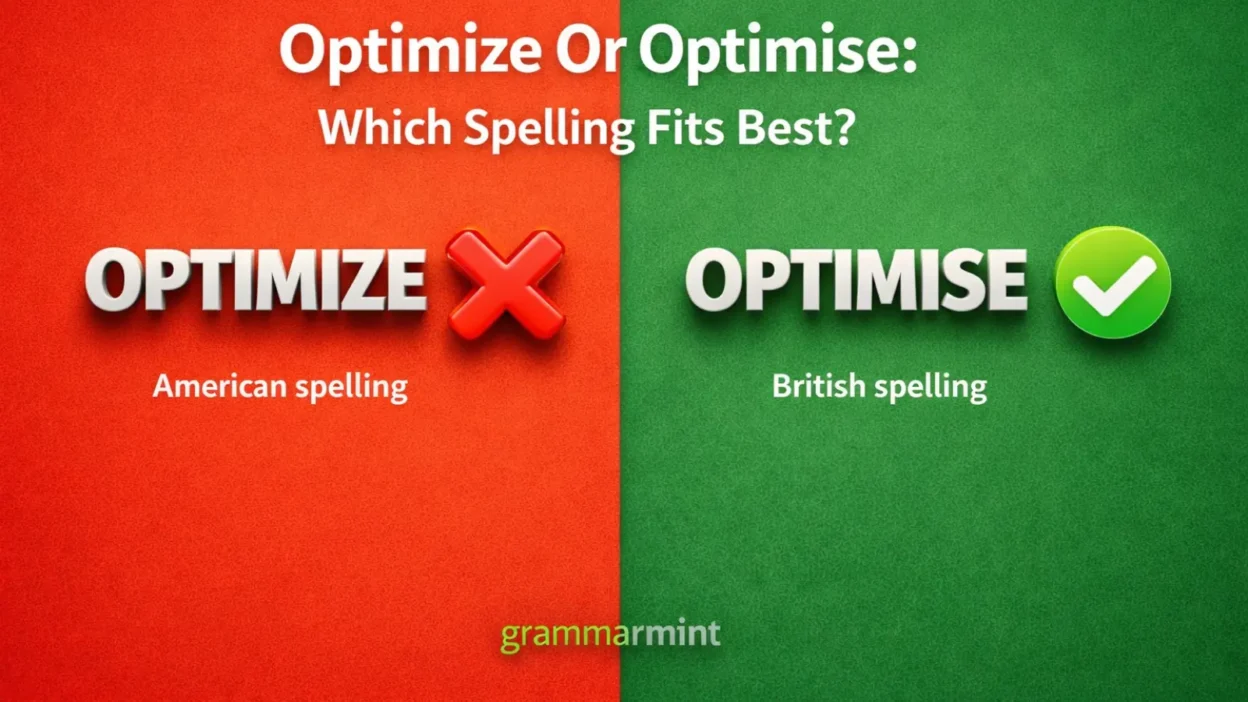
Optimize is the standard spelling for a USA audience. Optimise is the usual British spelling, though some British references also allow optimize. Use the form that matches your readers, then stay consistent.
TL;DR
• Use optimize for American readers
• Use optimise for many British readers
• Both forms mean the same thing
• Match the rest of your spelling style
• Don’t mix both in one document
Optimize Meaning
At its core, the word is simple. It means making something better, more useful, or more effective.
• Verb that means improve performance
• Improve a process step by step
• Make something more effective overall
• Often used in business writing
• Also common in software writing
• Fits planning and workflow topics
• Suggests a better final result
• Can describe time or energy use
• Works for systems and habits
• Usually sounds formal but clear
• Not limited to technical fields
• Often replaces “make better” neatly
Optimise Meaning
This section is short because the meaning does not change. Only the spelling changes.
• British spelling of the same verb
• Carries the same meaning as optimize
• Functions as a regional variant
• Common in UK-facing writing
• Common in Australia too
• Seen in British business copy
• Used in reports and guides
• Works in formal prose
• Also appears in tech writing
• Sounds standard to UK readers
• Not a different level of formality
• Means improve for best results
Optimize Vs Optimise
So which one wins? The answer depends on audience, not intelligence.
• It’s a spelling choice, not meaning change
• Your audience decides the better fit
• Your region shapes the default form
• USA usually prefers optimize
• UK often prefers optimise
• Both are widely understood
• Neither form is slang
• Neither form sounds childish
• The difference is visual
• Pronunciation stays essentially the same
• Meaning stays fully matched
• Consistency matters more than debate
Optimize In American English
For a USA audience, the answer is straightforward. Use the American form and move on.
• American English favors optimize
• Best for US readers everywhere
• Treat it as the default form
• Use it in resumes
• Use it in marketing copy
• Use it in class papers
• Use it in app messages
• Use it in workplace emails
• Use it in product notes
• Use it in training materials
• Use it in blog writing
• Use it in everyday editing
Optimise In British English
Now for the UK side. British readers often expect the -ise form first.
• British English often uses optimise
• Common across the Commonwealth too
• Usually the usual form in UK style
• Fits British school writing
• Fits British workplace copy
• Fits UK customer messaging
• Fits local government wording
• Fits British blog content
• Fits UK product text
• Often appears in edited British prose
• Natural for many UK readers
• Best when the full document is British
Can You Use Optimize In British English
Here’s the nuance many short posts miss. British usage is not always one-rule-only.
• Some UK references mark it accepted
• Choice can follow a style guide
• Still, keep consistency throughout
• Oxford-style writing may use -ize
• Other UK styles prefer -ise
• Readers usually understand both
• Mixed documents feel less polished
• House style can override habit
• Team standards should come first
• Local expectations still matter
• Formal editing should pick one
• Consistent pages build trust faster
Optimization Vs Optimisation
The same regional pattern continues in the noun form. Once you choose the verb, keep the noun aligned.
• Noun form follows the verb choice
• American form uses -zation
• British form often uses -sation
• Optimize becomes optimization in US style
• Optimise becomes optimisation in UK style
• Don’t switch families mid-page
• Match headings and body text
• Match menus and labels
• Match captions and tables
• Match slides and handouts
• Match reports and summaries
• Same meaning in both forms
Optimized Or Optimised
Past forms matter because they show up in reports, edits, and status updates. The same rule still applies.
• Past tense follows your region
• Also works as an adjective
• Use in edited text carefully
• US: optimized workflow
• UK: optimised workflow
• US: we optimized costs
• UK: we optimised costs
• Match screenshots and captions
• Match quotes only when appropriate
• Don’t silently rewrite source spelling
• Keep version names consistent
• Check headings after editing
Optimizing Or Optimising
The -ing form is common in titles, training pages, and process notes. Again, it is the same word family.
• Present participle follows the same rule
• Shows an ongoing action or process
• Can act as a gerund too
• US: optimizing performance
• UK: optimising performance
• Useful in article titles
• Useful in meeting notes
• Useful in checklists
• Useful in learning materials
• Useful in app tooltips
• Useful in workflow docs
• Useful in status updates
How To Spell Optimize
Spelling gets easier when you stop treating this as a trick question. Think audience first, then pattern.
• Start with spelling by audience
• Use a quick memory trick
• Then double-check nearby forms
• US document means optimize
• UK document often means optimise
• Noun form should match
• Past form should match
• -ing form should match
• Browser language may influence spelling
• Spellcheck may flag the opposite form
• House style beats personal habit
• Final proofread catches mixed endings
Is Optimize Correct
Yes. For American English, it is fully standard.
• Correct in American usage
• A fully standard form
• Best match for US style
• Fine in school writing
• Fine in office writing
• Fine in product copy
• Fine in technical guides
• Fine in proposals
• Fine in headlines
• Fine in plain-language writing
• Fine in edited publications
• Not a misspelling at all
Is Optimise Correct
Yes again. It is a real, standard spelling in British usage.
• Also fully correct in context
• A valid UK style form
• Standard in many regional settings
• Fine in British reports
• Fine in UK emails
• Fine in Commonwealth materials
• Fine in local campaigns
• Fine in British course notes
• Fine in UK-facing websites
• Fine in edited copy
• Not a typo either
• Just avoid mixing styles
Common Writing Contexts
In practice, this choice shows up in more places than people expect. That is why consistency matters.
• Business writing needs one chosen style
• Academic writing should follow house rules
• Software text should stay uniform
• Marketing copy needs audience fit
• Email templates need one standard
• Product pages need aligned labels
• Training guides need stable spelling
• Slide decks need matched headings
• Reports need clean editing
• UX text needs regional clarity
• Cover letters should match employer region
• Student papers should match assignment style
Similar Spelling Pairs To Know
This pair is easier once you see the family pattern. Still, not every word follows the same shortcut.
• Organize pairs with organise
• Analyse pairs with analyze
• Maximise pairs with maximize
• Organization matches organisation regionally
• Organized matches organised regionally
• Analyzing matches analysing regionally
• Maximized matches maximised regionally
• Some words break simple patterns
• So never guess blindly
• Always check the family form
• Nearby pairs help memory
• Pattern awareness speeds editing
Common Mistakes To Avoid
Most mistakes happen during revision, not drafting. So the fix is usually simple.
• Avoid mixed spelling in one file
• Watch editing after copy-paste
• Protect consistency in headings
• Don’t switch verb families
• Don’t change quoted text carelessly
• Don’t trust one spellchecker fully
• Don’t mix US menus with UK body
• Don’t forget image captions
• Don’t ignore table labels
• Don’t vary button text randomly
• Don’t rewrite brand spellings
• Don’t overthink a settled audience
The same regional spelling pattern appears in <a href=”https://grammarmint.com/authorization-or-authorisation/“>authorization or authorisation</a>.
Easy Memory Tricks
You do not need a complicated rulebook here. A few fast reminders are enough.
• Remember the reader before the word
• Use a simple shortcut
• Match the reader and document style
• USA usually means z
• UK often means s
• Verb, noun, and -ing should match
• One page needs one system
• Team style should stay stable
• Templates should lock the choice
• Saved examples speed future writing
• Final scans catch visual clashes
• Audience first solves most doubt
The same regional spelling pattern appears in <a href=”https://grammarmint.com/traveled-or-travelled/“>traveled or travelled</a>, another common US-versus-UK English difference.
FAQs
Is optimize or optimise correct?
Both are correct. For a USA audience, use optimize. For many British audiences, optimise is the more natural choice.
Why are there two spellings?
English keeps regional spelling patterns. This pair follows the broader American-versus-British split that appears in several word families.
Is optimise British English?
Yes. It is a standard British spelling. However, some British references and style traditions also allow optimize, so context still matters.
Can you use optimize in British English?
Yes, sometimes. Some British dictionaries and Oxford-style usage accept it, but many British readers still expect optimise, so consistency matters.
What is the noun form of optimize?
The noun is optimization in American English and optimisation in British English. Match the noun to the verb style you already chose.
Which spelling should I use in America?
Use optimize. That is the standard American form for business, school, product, and everyday writing.
A similar regional pattern appears in <a href=”https://grammarmint.com/summarize-or-summarise/“>summarize or summarise</a>, another common US–UK spelling difference.
Conclusion
For a USA audience, Optimize or Optimise usually ends with one easy choice: use optimize.
If your audience is British, optimise is often the safer fit.
Pick the version your readers expect, then keep the full word family consistent.