If you’ve ever paused while typing Etc or Ect, you’re not alone. This mix-up shows up in texts, emails, captions, school papers, shopping lists, and even business notes because et cetera, abbreviation, punctuation, period, comma, formal writing, and misspelling rules all get tangled together fast. The good news is that this one is easier than it looks: one form is standard, and the other is not. In this guide, you’ll see what etc. means, why people write ect, how pronunciation adds confusion, and when to use or avoid it in everyday American English.
Quick Answer
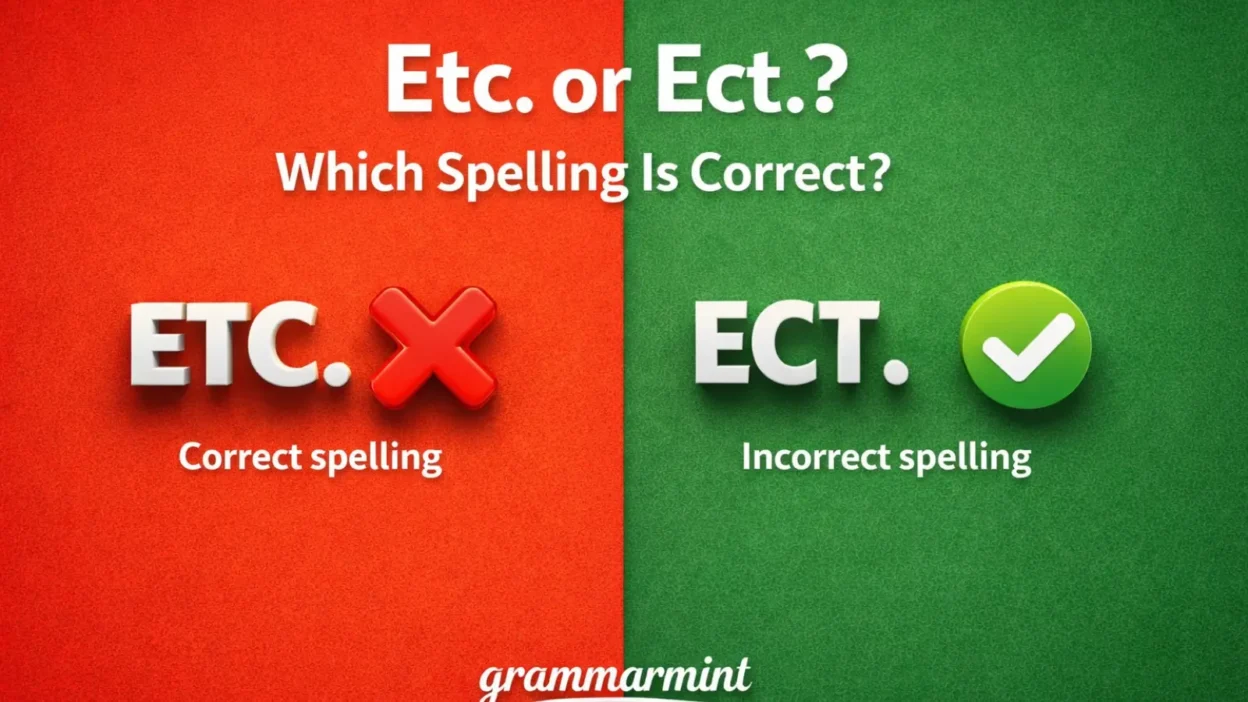
Etc or Ect? The correct form is etc. because it abbreviates et cetera. Ect is a misspelling in normal English writing, though all-caps ECT can be a separate acronym in other contexts.
TL;DR
• Write etc., not ect
• It means “and the rest”
• Use it after similar items
• Keep the final period
• Skip “and etc.”
• Use et al. for people
Is It Etc. Or Ect.?
The correct spelling is etc. The form ect is a common misspelling, not the standard abbreviation for et cetera.
• Use etc. in standard English writing.
• Skip ect in school, work, and publishing.
• Think et plus cetera, not ec plus tera.
• The letters stay in Latin order.
• Edited prose uses etc., not ect.
• Spellcheck usually catches ect fast.
• Readers notice the swap quickly.
• The error looks rushed and casual.
• Fortunately, the fix is simple.
• Write etc. and move on.
• Save ECT for separate acronym meanings.
• When unsure, spell out et cetera.
What Does Etc. Mean?
As a list marker, etc. means and the rest or “and other similar things.” It works when readers can easily infer the remaining items from the examples you already gave.
• It signals more similar items follow.
• It means and the rest.
• It can mean and so on.
• Use it after a partial list.
• The category should stay obvious.
• Readers should infer the missing items.
• Food lists fit this well.
• Tool lists fit this too.
• Office items also work nicely.
• Random categories weaken the meaning.
• So, keep examples clearly related.
• Use it to trim long lists.
What Is The Full Form Of Etc.?
The full form of etc. is et cetera, a Latin phrase. The parts matter: et means “and,” and cetera means “the rest” or what remains.
• The full form is et cetera.
• In Latin, et means and.
• In Latin, cetera means the rest.
• Together, it means and other things.
• The abbreviation keeps the key letters.
• That is why c stays put.
• The full phrase still appears in prose.
• However, etc. is more common daily.
• The short form saves space.
• Most readers know both forms.
• Spelling still has to stay exact.
• So the order never becomes ect.
Difference Between Etc. And Et Cetera
These two forms have the same meaning. The real difference is length and tone, not definition.
• They mean the same thing.
• One form is full length.
• The other form is shortened.
• Et cetera feels slightly more formal.
• Etc. feels quicker and lighter.
• Both belong after list examples.
• Both imply omitted similar items.
• Choose one style and stay consistent.
• In short notes, etc. usually wins.
• In polished prose, either can work.
• Never stack both together awkwardly.
• Pick the form that fits tone.
Is Ect. Ever Correct?
For this word-choice question, lowercase ect is not correct. Still, ECT in all caps can be a separate acronym in fields like medicine, so context matters.
• Lowercase ect is not accepted here.
• It counts as a spelling mistake.
• Writers usually mean etc. instead.
• The error often begins in speech.
• Some speakers say eksetera aloud.
• Then the letters get reversed.
• In this topic, avoid ect completely.
• However, all-caps ECT can differ.
• Medical writing may use ECT separately.
• General lists still need etc.
• So lowercase ect stays wrong.
• Context decides any capitalized acronym meaning.
How Do You Pronounce Etc.?
Standard pronunciation follows et cetera, and major reference sources give forms based on that pattern. A nonstandard “eksetera”-type pronunciation helps explain why some people mistakenly write ect.
• Say et-SET-uh-ruh in full.
• Many speakers shorten it slightly.
• Keep the t sound clear.
• The c sounds like s here.
• Don’t turn it into eksetera.
• That version is considered nonstandard.
• In speech, many say et cetera.
• Some read the abbreviation aloud.
• Either way, spell it etc.
• Pronunciation does not change spelling.
• So hearing a k can mislead.
• Writing should follow the standard form.
When Should You Use Etc.?
Use etc. when you have a partial list of similar items and do not need to name every single one. It works best when the category is obvious and the sentence stays clear.
• Use it after clear, related examples.
• Give at least two items first.
• Keep the category easy to guess.
• Grocery lists are a natural fit.
• Office supplies work well too.
• Travel gear lists make sense.
• Meeting tasks can end with etc.
• Simple examples keep readers oriented.
• Use it when full detail adds little.
• Use it when space feels tight.
• Use it once per sentence.
• Let context supply the rest.
When Should You Avoid Etc.?
Avoid etc. when precision matters or when your examples do not form a clear set. It can also sound vague in writing that needs full detail.
• Avoid it with one example only.
• Avoid it in exact instructions.
• Avoid it in legal details.
• Avoid it in scientific methods.
• Avoid it after complete sets.
• Avoid it with mixed categories.
• Avoid it after e.g.
• Avoid it after for example.
• Avoid it when every item appears.
• Avoid it where precision matters.
• Avoid repeating it for effect.
• Instead, finish the list clearly.
Do You Put A Period After Etc.?
Yes. Because etc. is an abbreviation, it keeps a period. If it lands at the end of a sentence, that single period does the job, so you do not add another one.
• Yes, the period stays.
• It marks an abbreviation clearly.
• Write etc. with its period.
• Keep the period mid-sentence too.
• Keep the period at sentence end.
• Do not add two periods.
• One period is enough there.
• Questions keep their question mark too.
• Exclamations keep their exclamation mark too.
• Semicolons can follow after the period.
• Parentheses can include etc. neatly.
• Normal sentence punctuation still applies.
Should There Be A Comma Before Etc.?
In many American styles, especially serial-comma style, writers place a comma before etc. If the sentence continues after etc., you may also need a second comma based on the sentence structure.
• In many US styles, yes.
• Place one before etc. in lists.
• This is common in edited prose.
• Mid-sentence, another comma may follow.
• That second comma depends on syntax.
• Example: labels, folders, etc., were delivered.
• Sentence-final use needs no second comma.
• Example: We packed chargers, cords, etc.
• Style guides can vary a little.
• So check house style if needed.
• Smooth reading matters most.
• Keep list punctuation consistent throughout.
Can You Write “And Etc.”?
No. And etc. is redundant because et already means “and.” The same problem applies to “and et cetera.”
• No, avoid and etc.
• Et already means and.
• The phrase doubles the meaning.
• Readers hear needless repetition immediately.
• Drop the extra and fast.
• Use etc. by itself instead.
• Or write and more.
• Or write and other items.
• Short lists sound cleaner this way.
• Formal writing especially avoids it.
• The same goes for and et cetera.
• Choose one ending, not both.
Etc. Vs. Et Al.
Use etc. for things or categories. Use et al. for people, especially named authors or participants in academic and formal contexts.
• Use etc. for things.
• Use et al. for people.
• Lists of authors need et al.
• Lists of snacks need etc.
• Both come from Latin roots.
• Yet they do different jobs.
• Don’t swap one for the other.
• Academic citations often use et al.
• Everyday lists often use etc.
• People names make the difference obvious.
• Objects and categories point to etc.
• Ask what your list contains.
Is Etc. Formal Or Informal?
Etc. appears in both business writing and everyday writing, but very formal or academic work may prefer fuller wording or exact lists. The right choice depends on audience, tone, and how much precision readers need.
• It works in both settings.
• Still, tone matters a lot.
• Casual writing welcomes etc. easily.
• Academic writing may prefer specifics.
• Formal reports may spell it out.
• Business writing often keeps etc.
• Vague lists weaken serious arguments.
• Precise lists strengthen careful writing.
• Use audience expectations as your guide.
• If detail matters, skip etc.
• If brevity helps, use it.
• Let clarity make the decision.
Etc. In A Sentence
Good sentence examples make the rule easy: list a few similar items, then end with etc. only when the missing items are obvious.
• Bring pens, folders, sticky notes, etc.
• We packed shirts, socks, chargers, etc.
• She studies algebra, biology, history, etc.
• Order plates, cups, napkins, etc. today.
• The app stores photos, files, notes, etc.
• Kids drew rockets, planets, stars, etc.
• He handles budgeting, hiring, scheduling, etc.
• Please review invoices, receipts, logs, etc.
• We streamed comedies, thrillers, dramas, etc.
• Pack sunscreen, sandals, hats, etc. first.
• They sold muffins, cookies, brownies, etc.
• Her hobbies include sewing, baking, gardening, etc.
British Vs. American English
This is not a US-vs-UK spelling split. In both varieties, the standard form is etc., not ect.
• Both English varieties use etc.
• Neither prefers ect instead.
• The spelling stays the same.
• The main differences are stylistic.
• Comma habits may vary by publisher.
• Period habits may vary by house style.
• Yet the abbreviation stays etc.
• So this is not color versus colour.
• It is not a regional split.
• US readers expect etc. readily.
• UK readers understand etc. readily.
• The confusion is spelling, not region.
Common Mistakes With Etc.
The most common mistakes are ect, a missing period, bad list logic, and redundant phrasing. Thankfully, each one has a quick fix.
• Writing ect instead of etc.
• Dropping the final period.
• Adding and before etc.
• Using it after one item.
• Mixing unrelated categories together.
• Repeating etc. twice in one sentence.
• Using it after e.g.
• Using it after for example.
• Adding extra periods at the end.
• Using it where precision matters.
• Confusing it with et al.
• Forgetting audience and tone.
FAQs
What Does Etc. Stand For?
It stands for et cetera, a Latin phrase meaning “and the rest” or “and other similar things.” In normal English writing, etc. is the standard abbreviation.
Is Ect. Ever Correct?
Not when you mean et cetera. Lowercase ect is a misspelling here, though uppercase ECT can mean something else in a different field.
Should I Always Put A Period After Etc.?
Yes. Since etc. is an abbreviation, it keeps its period, and if it ends the sentence, that one period is enough.
Can I Use Etc. In Formal Writing?
You can, but only when the omitted items are obvious. In highly formal or academic writing, a fuller list or more precise wording may read better.
Do I Need A Comma After Etc. In The Middle Of A Sentence?
Sometimes, yes. If the sentence structure would normally call for a comma there, etc., can take one after its period.
What’s The Difference Between Etc. And Et Al.?
Use etc. for things, categories, or examples. Use et al. for people, especially in author lists and citations.
Conclusion
For Etc or Ect, the answer is simple: write etc. and skip ect.
Once you remember et cetera, the spelling, punctuation, and usage get much easier.
Use it when the list is clear, and leave it out when readers need precision.