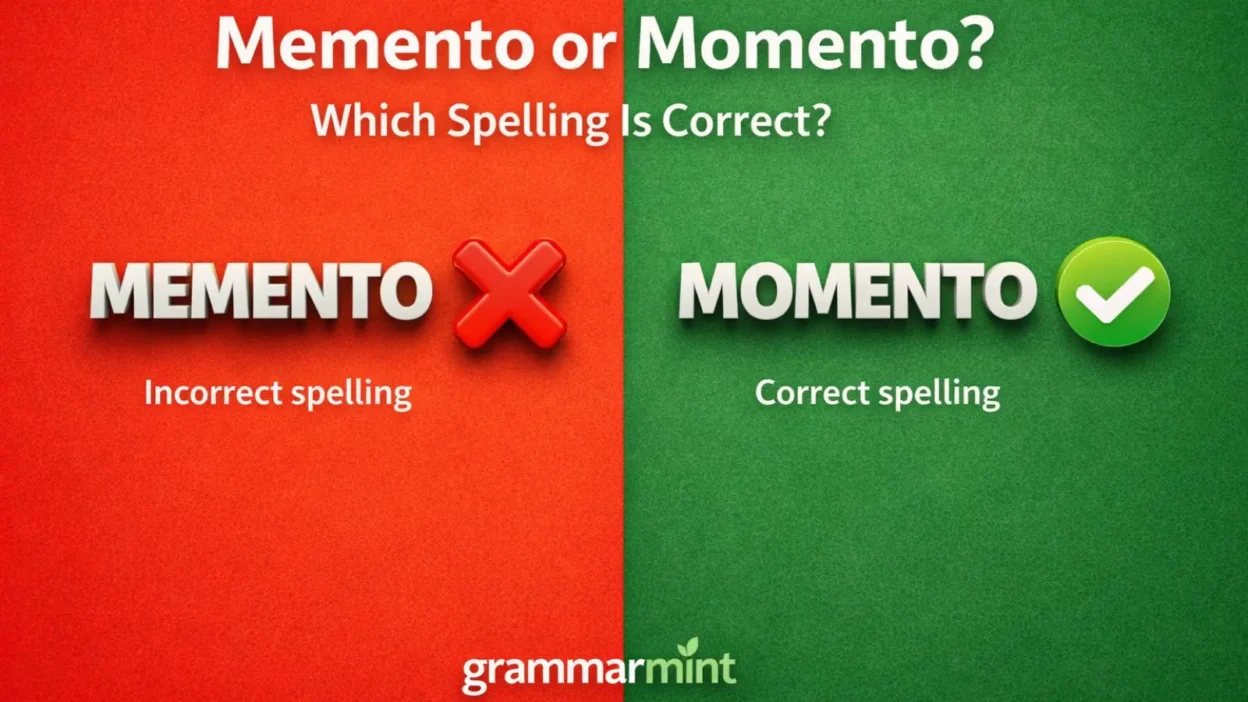
If you’re writing a card, caption, email, or article, you may pause at memento or momento and wonder which one looks right.
That confusion is common because the word sounds close to moment, shows up near words like souvenir, keepsake, memory, reminder, and token, and even overlaps with the Latin phrase memento mori.
So, this guide clears it up in plain English. You’ll learn which spelling to use, what the word means, why people write the other version, how the plural works, how to say it, and what to do in formal writing.
Quick Answer
Memento or momento: the standard English spelling is memento. Use memento for a keepsake, souvenir, or reminder. In most modern writing, momento looks like a mistake.
TL;DR
• Use memento in standard English
• It means a keepsake or reminder
• Momento still looks risky
• Formal writing should avoid momento
• The plural is usually mementos
• Think memory, not moment
Standard Spelling
If your goal is clean, natural English, choose memento. That is the correct spelling in standard English for normal writing.
Even so, many people type the other form first. That happens because the eye expects moment.
• Memento is the standard choice
• Use it in school and work
• Use it in captions too
• Use it in product copy
• Use it in thank-you notes
• Use it in award text
• Use it in travel writing
• Use it in gift messages
• Use it in memory books
• Use it in family keepsake labels
• Use it in polished articles
• Avoid second-guessing the spelling
Meaning Of Memento
A memento is a keepsake, souvenir, or reminder of a person, place, time, or event. Usually, it is something small that helps bring back a memory.
It can be physical or emotional in tone. Still, the most common use is a real object.
• A shell from a beach trip
• A ticket from a concert
• A photo from graduation day
• A pin from a conference
• A note from a friend
• A bracelet from a partner
• A medal from a race
• A postcard from Paris
• A toy from childhood
• A program from a wedding
• A ribbon from an event
• A small gift with meaning
Side-By-Side Comparison
This is the fast contrast most readers want. The difference is simple once you see it clearly.
One form is the safe standard. The other usually creates doubt.
• Memento = standard English spelling
• Momento = risky modern choice
• Memento = keepsake meaning
• Momento = often seen as error
• Memento = best for editing
• Momento = may distract readers
• Memento = safer in headlines
• Momento = weaker in formal copy
• Memento = trusted by teachers
• Momento = invites correction
• Memento = better for publication
• Momento = best avoided generally
Why People Write Momento
The mistake makes sense at first glance. After all, memento helps you remember a moment, so writers naturally drift toward that shape.
Also, the sound does not strongly warn you away. That is why this typo keeps spreading.
• Moment pulls the spelling off course
• Pronunciation hides the middle vowel
• Fast typing causes letter swaps
• Memory and moment feel linked
• Autocorrect is not always enough
• The word looks visually plausible
• Some people learn it by sound
• Others copy it from casual posts
• Foreign-language overlap adds confusion
• Rare dictionary notes muddy the issue
• Readers trust familiar letter patterns
• Repetition makes the error feel normal
Is Momento Ever Acceptable?
Here is the nuanced part. In modern standard writing, momento is still not the best choice.
However, some dictionaries list it as a variant or disputed form. Even so, that does not make it the smartest option for everyday use.
• It may appear in some dictionaries
• It is still not the safest choice
• Many readers treat it as wrong
• Editors often change it quickly
• Teachers usually prefer memento
• Brands may use odd spellings
• Names can break normal rules
• Quoted text may preserve it
• Historical usage can differ sometimes
• Casual posts may contain it
• Formal copy should still avoid it
• Clear writing favors memento instead
Formal Writing Choice
When the audience matters, choose the safer form. In formal writing and professional use, the safest choice is memento.
That includes resumes, school essays, award copy, museum labels, speeches, and business materials. Readers expect the standard form there.
• Use memento in business emails
• Use memento in brochures
• Use memento in plaques
• Use memento in school essays
• Use memento in formal speeches
• Use memento in press materials
• Use memento in certificates
• Use memento in product descriptions
• Use memento in invitations
• Use memento in donor gifts
• Use memento in museum text
• Use memento in presentations
British Vs American English
This is not really a US-versus-UK split. In both American English and British English, memento is the recognized standard spelling.
So, do not treat momento as a British alternative. That myth causes extra confusion.
• The standard form stays the same
• US writers use memento
• UK writers use memento
• There is no major regional split
• The spelling is not Americanized
• The spelling is not Anglicized
• Style guides favor the standard form
• Readers expect the same answer
• The risk stays similar everywhere
• Formal usage remains consistent
• Cross-border writing should stay standard
• The myth is easy to drop
Pronunciation And Sound
The usual pronunciation is close to muh-MEN-toh. The middle sound can blur in fast speech, which partly explains the spelling mix-up.
Still, spoken similarity should not drive your spelling choice. Use the written standard, not the guessed sound.
• Say it like muh-MEN-toh
• Stress the middle syllable
• Keep the first vowel soft
• The last sound is “toh”
• Fast speech can blur details
• That blur can trigger mistakes
• Clear speech helps memory
• Slow reading helps spelling
• Saying it aloud can help
• Hearing it once is useful
• Writing it twice locks it in
• Sound alone is not enough
Origin And Word History
The word comes from Latin and links to remember. That history helps explain why the standard spelling uses e, not o in the middle.
Once you connect it to memory, the spelling becomes easier to keep. That is a better anchor than thinking about moment.
• It comes from Latin roots
• It connects with remembering
• The history supports the spelling
• Memory is the better clue
• Moment is the misleading clue
• Old meanings included warning too
• Keepsake became a common sense
• The word has deep history
• The spelling is not random
• Etymology supports the standard form
• Memory beats guesswork here
• Origin makes the choice stick
Plural Forms
The usual plural is mementos. You may also see mementoes, but it is less common in everyday American writing.
So, when in doubt, use the shorter plural. It looks cleaner and more current.
• One memento, two mementos
• Mementos is the usual plural
• Mementoes also exists
• The shorter plural feels simpler
• American writing prefers mementos
• Headings look cleaner with mementos
• Labels favor the shorter form
• Product copy favors the shorter form
• School writing can use mementos
• Both forms are understood
• One form is just more common
• Choose one and stay consistent
Everyday Examples
The best way to learn this word is to see it in real-life contexts. These examples keep the meaning simple and natural.
Notice how the word usually points to a physical object with emotional value. That pattern stays steady.
• A photo became her travel memento
• He kept the stub as a memento
• The charm was a wedding memento
• She bought a small memento downtown
• The shell served as a beach memento
• His medal remained a proud memento
• The note became a quiet memento
• We packed one memento each
• The museum sold event mementos
• Grandma saved every holiday memento
• The ring box felt like a memento
• The postcard stayed in my journal
Common Mistakes To Avoid
Most errors here are easy to fix. Usually, the problem is one wrong vowel or a word that fits the sound but not the spelling.
So, catch the error early and move on. You do not need a complicated rule.
• Writing momento by accident
• Confusing it with moment
• Treating it as a UK variant
• Assuming speech proves spelling
• Mixing plural forms randomly
• Using it without context
• Repeating it too often
• Choosing it for formal copy
• Capitalizing it without reason
• Replacing it with memo
• Forgetting its keepsake meaning
• Overthinking a simple choice
Better Alternatives When Needed
Sometimes memento is correct, but not ideal for tone. In those cases, a close substitute may sound more natural.
Pick the word that fits the setting. That keeps your writing smooth and reader-friendly.
• Keepsake feels warm and personal
• Souvenir suits travel contexts
• Token fits ceremony language
• Reminder sounds plain and direct
• Memorial item feels more formal
• Gift works when details matter less
• Badge fits event settings
• Photo works when specific
• Program suits ceremony copy
• Plaque fits award language
• Note suits sentimental writing
• Trinket works for casual tone
Memento Mori And Related Phrases
You may know the phrase memento mori already. It is a related Latin expression, but its meaning is more serious than everyday keepsake use.
In normal English, memento often means souvenir. In memento mori, it points to remembrance in a deeper, mortality-focused sense.
• Memento mori is a set phrase
• It carries a serious tone
• It relates to mortality
• It is not the same as souvenir
• The Latin form stays unchanged
• Writers often italicize it
• Artists use it symbolically
• The phrase has historical depth
• It can appear in philosophy
• It can appear in art writing
• It strengthens the memory link
• It is not spelled momento mori
Easy Memory Tricks
Spelling sticks better with a quick mental cue. The best one is simple: link memento to memory, not to moment.
That one shift solves most of the problem. Keep the memory clue, and the spelling settles down.
• Think memory starts with “me”
• Memento keeps that same opening
• A memento stores a memory
• Don’t chase the word moment
• Picture a labeled keepsake box
• Write it beside memory once
• Say “memory, memento” together
• Save the correct form in notes
• Use it in one sample sentence
• Read it slowly one time
• Notice the two e’s inside
• Trust the standard pattern
Final Usage Rule
After all the nuance, the rule is still simple. Use memento unless you have a special reason to preserve momento exactly as written.
That approach keeps your writing clear. It also prevents avoidable distractions.
• Choose memento by default
• Use it for keepsakes and reminders
• Use it across US writing
• Use it across UK writing
• Prefer it in edited work
• Prefer it in captions too
• Prefer it in school assignments
• Prefer it in formal notes
• Prefer it in gift language
• Keep momento out of polished copy
• Trust clarity over cleverness
• Let readers focus on meaning
FAQs
Is it memento or momento?
Use memento in standard English. While some dictionaries acknowledge momento as a variant, it still looks wrong to many readers, so memento is the safer choice.
Is momento a real word?
It appears in some dictionary listings as a variant or disputed form. Even so, it is not the form most writers should choose for clean, modern English.
What does memento mean?
A memento is a keepsake, souvenir, or reminder of a person, place, or event. Often, it is a small object with emotional value.
Why do people spell memento as momento?
People often connect the word with moment, and the pronunciation does not strongly block that guess. That makes the misspelling feel natural, even though it is not the best standard form.
What is the plural of memento?
The usual plural is mementos. You may also see mementoes, but the shorter form is more common in everyday American writing.
How do you pronounce memento?
Most English speakers say it close to muh-MEN-toh. The middle syllable gets the stress, which can help you remember the shape of the word.
Is momento British English?
No. Both American and British English generally use memento as the standard spelling. Momento is not the normal UK form.
Conclusion
For almost every reader and writer, memento or momento comes down to one practical answer: use memento.
It is the clearer, safer, and more standard choice.
When in doubt, think memory, then write memento.