If you have ever written an excited text message, social media comment, or casual conversation online, you have probably wondered whether the correct spelling is whoa or woah.
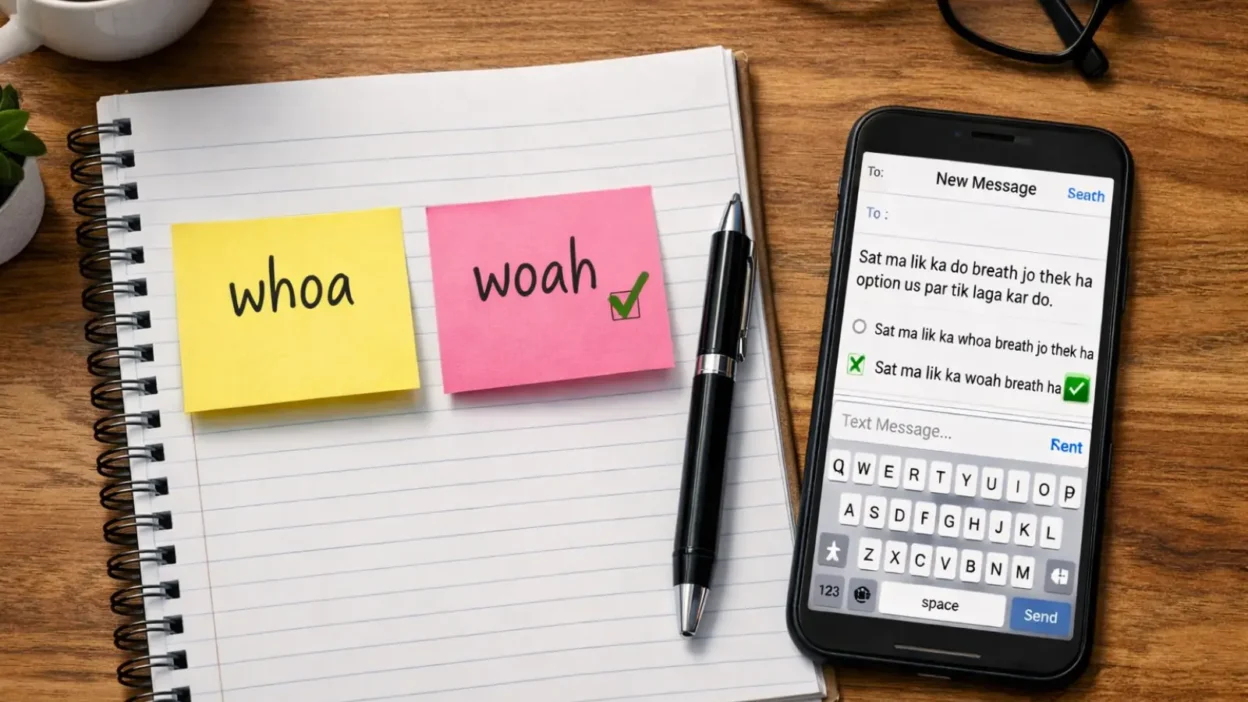
Both forms are widely recognizable, and both are used to express surprise, excitement, amazement, or a request to stop. However, they do not have exactly the same status in standard English. Whoa is the traditional and standard spelling, while woah is a common informal variant.
So, if you are writing something for school, work, a website, or another formal setting, whoa is generally the safer choice.
In this guide, we will explain the difference between whoa and woah, where each spelling is appropriate, why the variant woah became popular, and how to use these words naturally in everyday writing.
Quick Answer
Whoa is the standard spelling and the form you should generally use in formal or polished writing.
Woah is a common informal variant. You will often see it in text messages, social media posts, online comments, song lyrics, and other conversational writing.
The simple rule:
- Whoa = standard spelling
- Woah = informal variant
- Formal writing = prefer whoa
- Casual online writing = whoa or woah may appear
- Professional writing = whoa, or consider a more polished alternative such as wow
For example:
Whoa, that’s an amazing view!
This is the standard spelling.
You may also see:
Woah, that’s an amazing view!
The second version is easily understood, but it has a more casual and conversational feel.
What Does “Whoa” Mean?
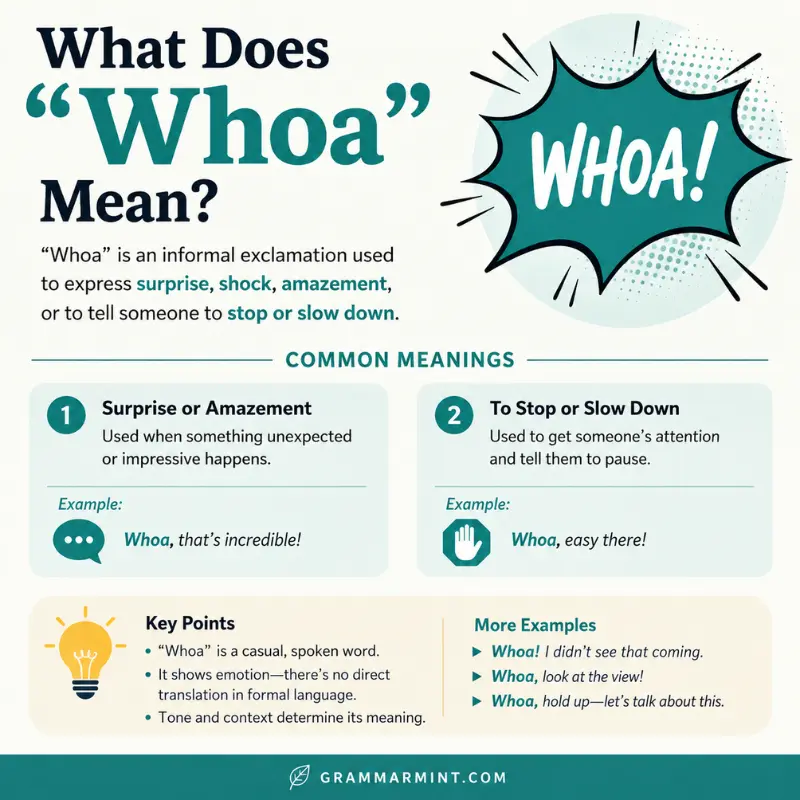
Whoa is an interjection used to express surprise, excitement, amazement, disbelief, or a request to stop or slow down.
Historically, whoa was especially associated with a command to a horse to stop or slow down. Over time, its use expanded beyond horses and became a general expression used in everyday conversation.
For example:
Whoa, slow down!
Here, whoa means something like “stop” or “slow down.”
It can also express surprise:
Whoa! I didn’t know you could do that.
In this sentence, the speaker is showing amazement or surprise.
Another example is:
Whoa, that was close!
Here, the word communicates a strong emotional reaction.
What Does “Woah” Mean?
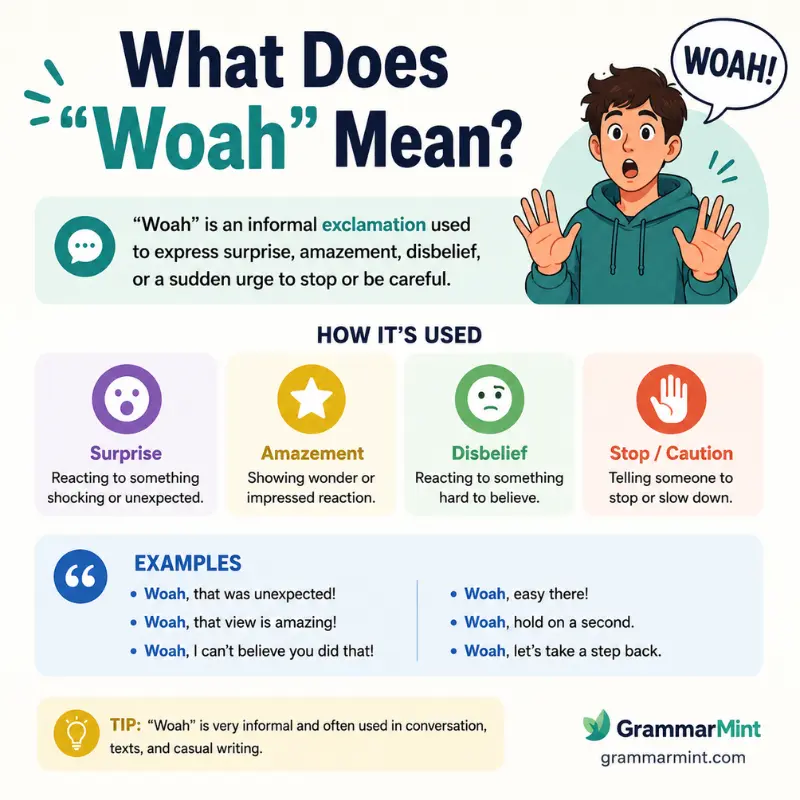
Woah generally carries the same meaning as whoa. It is commonly used as an informal spelling of the same interjection.
For example:
Woah, that’s incredible!
The writer is expressing surprise or excitement.
You may see woah frequently in:
- Text messages
- Social media posts
- Online comments
- Internet forums
- Casual conversations
- Informal captions
- Creative writing intended to sound conversational
The important point is that woah is not usually treated as the preferred standard spelling when careful or formal English is expected.
Whoa vs Woah: Key Differences
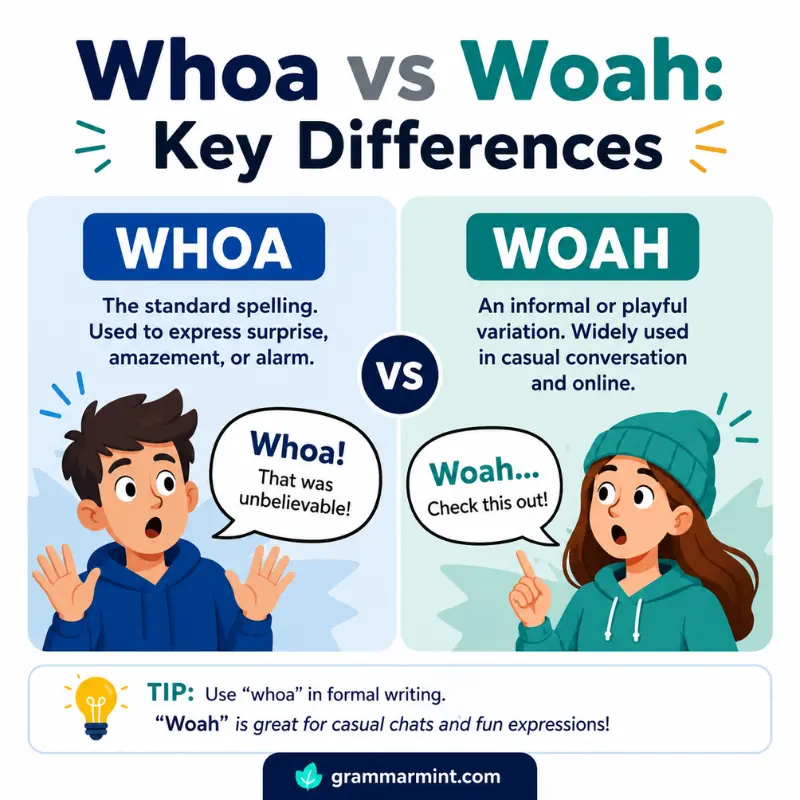
The biggest difference between the two forms is usage and spelling status, not meaning.
| Feature | Whoa | Woah |
|---|---|---|
| Standard spelling | Yes | Informal variant |
| Meaning | Surprise, amazement, stop, etc. | Same |
| Formal writing | Preferred | Usually avoid |
| Texting | Common | Very common |
| Social media | Common | Common |
| Professional writing | Better choice | Less appropriate |
| Pronunciation | Usually the same | Usually the same |
In other words, the two words generally communicate the same idea, but whoa has stronger status in standard edited English.
Why Are There Two Spellings?
The existence of whoa and woah is not particularly surprising because interjections often develop different spellings.
Interjections are words that represent spontaneous reactions or sounds. Since people often learn them through speech rather than formal instruction, they can be spelled in several ways.
The traditional spelling whoa became established in English as a command associated with stopping or slowing a horse. As the word became more widely used to express surprise and amazement, its spelling remained whoa.
The spelling woah likely developed because it represents the pronunciation in a way that feels more intuitive to some writers. Informal internet communication has also helped variants spread quickly.
When people type quickly, they may spell a word according to how they hear it. Once enough people use that spelling, it can become recognizable even if it is not the traditional standard form.
Is “Woah” Wrong?
It is better to describe woah as an informal variant rather than simply calling it “wrong.”
Language changes through everyday use, and woah is clearly understood by English speakers. It appears frequently in casual digital communication and other informal contexts.
However, if your goal is to follow standard English conventions, whoa is the better choice.
Think of it this way:
Whoa = the conventional spelling
Woah = a widely recognized informal spelling
That distinction is more useful than saying one form is completely understandable and the other is completely incorrect.
Whoa vs Woah in American English
In American English, whoa is the standard spelling.
You may encounter woah in informal American writing, particularly online, but it does not replace whoa as the conventional spelling.
For example:
Whoa, that car is fast!
is the standard version.
A casual social media post might say:
Woah, that car is fast!
The meaning remains clear, but the second version feels more relaxed and speech-like.
Whoa vs Woah in British English
British English also commonly uses whoa as the standard spelling.
There is no general rule saying that British English uses woah while American English uses whoa. That is a common misconception.
The spelling woah can appear in British online communication, just as it can in American online communication. Its use is mainly associated with informality rather than a particular national variety of English.
So whether you are writing American or British English, whoa is the safest standard form.
When Should You Use “Whoa”?
Use whoa when you want the conventional spelling and especially when your writing needs to look polished.
Good situations include:
- School assignments
- Articles
- Professional communication
- Business writing
- Edited publications
- Educational content
- Formal or semi-formal websites
- General writing where standard spelling is expected
For example:
Whoa, I didn’t realize the meeting had been moved.
Or:
Whoa! That was an unexpected result.
If you are unsure which spelling to choose, whoa is the safest option.
When Can You Use “Woah”?
Woah can work in highly informal writing where a conversational or spontaneous tone is intended.
For example:
Woah, check out that sunset!
Or:
Woah! I can’t believe we actually won.
You might also intentionally use woah when writing dialogue and want the character’s language to feel casual.
For example:
“Woah, wait a minute. What just happened?”
In these situations, the informal spelling can fit the tone. It is not usually necessary to “correct” every instance of woah in a casual conversation.
Whoa vs Woah in Professional Writing
Professional writing generally benefits from consistency and standard spelling.
If you are writing a business email, report, presentation, or company article, whoa is preferable to woah.
However, there is another consideration: even whoa may sometimes sound too conversational for highly formal writing.
For example:
Whoa, those numbers are much higher than expected.
This is grammatically understandable, but a formal report might say:
The results were significantly higher than expected.
So the choice is not always simply whoa vs woah. Sometimes the best option is to replace the interjection entirely.
Whoa vs Woah in Text Messages
Texting is one of the places where both spellings are common.
You might write:
Whoa, you got here fast!
or:
Woah, you got here fast!
Neither is likely to confuse the person receiving the message.
Because texting is informal, many people prioritize tone and personality over strict adherence to standard spelling. The spelling woah can therefore feel perfectly natural in a friendly conversation.
Whoa vs Woah on Social Media
Social media is another environment where woah frequently appears.
For example:
Woah, this place is beautiful!
The informal spelling can make a post feel spontaneous and conversational.
However, if you are creating content for a professional brand, business account, educational website, or publication, whoa is generally the better choice.
For polished captions, headlines, and promotional content, standard spelling can make the writing appear more carefully edited.
Examples of “Whoa” in Everyday Writing
Here are several examples showing how whoa can be used naturally:
Expressing surprise:
Whoa, I didn’t expect to see you here!
Expressing amazement:
Whoa, this view is incredible.
Asking someone to slow down:
Whoa, slow down. You’re going too fast.
Reacting to unexpected news:
Whoa, that’s a big change.
Reacting to a close call:
Whoa, that was almost a disaster!
Examples of “Woah” in Casual Writing
The following examples show how woah may appear in informal communication:
Woah, that movie was intense!
Woah, you actually did it!
Woah, look at the size of that building.
Woah, I wasn’t ready for that ending.
These sentences are easy to understand, but woah gives them a more casual, internet-friendly tone.
Common Mistakes With Whoa and Woah
Mistake 1: Assuming “Woah” Is the Standard Spelling
Because woah is common online, some writers assume it is the primary dictionary form.
Better approach: Use whoa when standard English is expected.
Mistake 2: Assuming “Woah” Has a Different Meaning
Usually, whoa and woah do not represent different meanings.
Better approach: Think of them as different spellings of the same informal interjection, with whoa being the standard form.
Mistake 3: Using “Woah” in Formal Writing
A casual spelling can make formal writing look less polished.
Better approach: Use whoa, or replace the interjection with a more precise expression.
Mistake 4: Assuming British English Uses “Woah”
There is no general British-English rule that favors woah.
Better approach: Use whoa as the standard form in both major varieties.
Mistake 5: Mixing Spellings Without a Reason
Switching randomly between whoa and woah can make a piece of writing look inconsistent.
Better approach: Pick the spelling that fits your audience and maintain it throughout the same piece.
Which Is More Common: Whoa or Woah?
Whoa is generally the more established and standard spelling. It has a long history in English and is the form most writers should choose when following conventional spelling.
Woah is highly visible because informal digital communication allows alternative spellings to spread quickly. Social media, texting, online communities, and conversational writing have all contributed to its popularity.
Popularity online, however, does not automatically make a spelling the preferred form in formal edited English.
Quick Comparison by Context
| Context | Recommended Choice | Reason |
| Academic essay | Whoa or rephrase | Standard spelling |
| Professional email | Whoa or rephrase | More polished |
| Business report | Rephrase | Interjections may sound too casual |
| Text message | Whoa / Woah | Both are easily understood |
| Social media comment | Whoa / Woah | Informal tone allows either |
| Personal chat | Whoa / Woah | Casual usage |
| Formal article | Whoa | Standard form |
| Character dialogue | Whoa / Woah | Depends on intended voice |
| Horse command | Whoa | Traditional spelling |
FAQs
Is “whoa” or “woah” correct?
Whoa is the standard spelling. Woah is a common informal variant.
Is “woah” a real word?
Yes, woah is widely used and understood, especially in informal communication. However, whoa is the conventional standard spelling.
Does “whoa” mean stop?
Traditionally, yes. Whoa was used as a command to make a horse stop or slow down. Today, it is also commonly used to express surprise, excitement, or amazement.
Can I use “woah” in a text message?
Yes. Woah is common in casual texting and is unlikely to cause confusion.
Should I use “whoa” in a school essay?
If you need to use the interjection, whoa is the safer spelling. Depending on the essay’s tone, however, a more formal expression may be better.
Is “woah” an American spelling?
No. Woah is not specifically an American spelling. It is an informal variant that can appear in different varieties of English.
Do whoa and woah sound different?
Generally, no. They are normally pronounced the same way and are used to represent the same sound.
Mini Quiz
1. Which spelling is preferred in standard English?
A. Woah
B. Whoa
Answer: B. Whoa
2. Which spelling might you see in a casual text?
A. Whoa
B. Woah
C. Both
Answer: C. Both
3. Which version is better for a professional email?
A. Woah
B. Whoa
C. Either, with no difference in tone
Answer: B. Whoa
4. What can “whoa” express?
A. Surprise
B. Amazement
C. A command to stop or slow down
D. All of the above
Answer: D. All of the above
Conclusion
When choosing between whoa and woah, remember one simple rule: whoa is the standard spelling, while woah is an informal variant.
Both forms are widely understood, and you will encounter woah frequently in texting, social media, online conversations, and other casual settings. There is nothing confusing about the variant, but it is generally not the best choice when you are expected to follow standard, polished English.
Use whoa in articles, school assignments, professional communication, and other edited writing. In casual conversations, woah can be used when you want a relaxed, spontaneous tone.
If you are ever unsure, choose whoa. It is the conventional spelling and works across formal, professional, and casual contexts.
In short: Whoa is the standard choice. Woah is the casual variant.