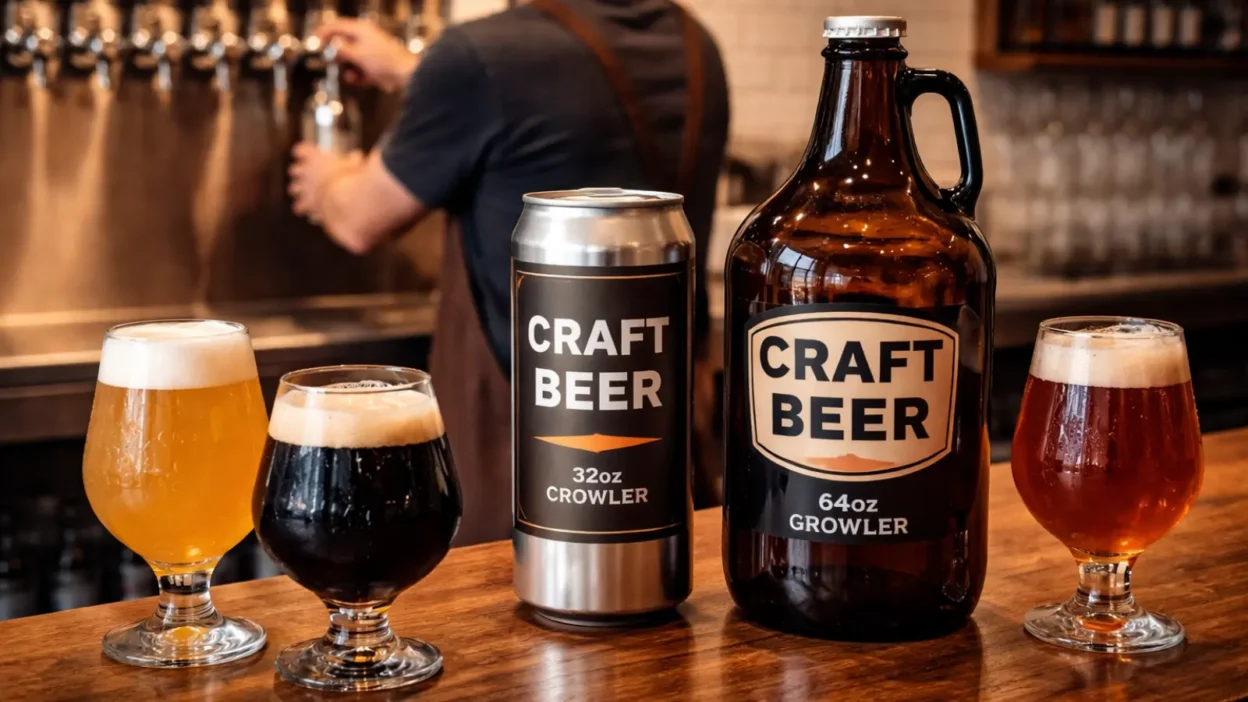
Draft beer fans often hear two similar-sounding terms: crowler and growler. Both are containers used to take fresh beer home from a brewery, taproom, or bar, but they are not the same. The confusion starts because the words look alike and both are associated with draft beer “to go.”
Knowing the difference can help you choose the right container for your situation, whether you are grabbing beer after work, planning a picnic, taking drinks to a party, or simply trying a limited-release beer at home.
At a basic level, a growler is a reusable container, traditionally a glass jug but also commonly made from stainless steel or other materials. A crowler is a can filled with draft beer and mechanically sealed at the brewery or taproom. The two containers serve a similar purpose, but their size, construction, portability, storage, and reuse are different.
Quick Answer
A crowler is typically an aluminum can filled with draft beer and sealed at a brewery or taproom. The most common size is 32 ounces, although other sizes can be available.
A growler is a larger, refillable container used to transport draft beer. A 64-ounce growler is a common size, but 32-ounce, 1-liter, and other versions are also available.
In simple terms:
- Crowler = sealed can of draft beer
- Growler = reusable draft-beer container
- Crowlers are usually disposable/recyclable
- Growlers are designed to be washed and refilled
- Neither term is interchangeable with the other
Key Differences at a Glance
| Feature | Crowler | Growler |
|---|---|---|
| Typical material | Aluminum | Glass, stainless steel, or other reusable materials |
| Common size | 32 oz | 64 oz |
| Reusable? | Generally no | Yes |
| How it is sealed | Seamed like a can | Cap, stopper, or specialized lid |
| Portability | Very convenient | Heavier, especially glass |
| Light protection | Excellent | Depends on material |
| Best for | Travel, picnics, short-term storage | Sharing, refilling, home use |
| Environmental advantage | Recyclable | Reusable |
These are general differences rather than strict rules. Breweries may offer different sizes, materials, and filling methods.
What Is a Crowler?
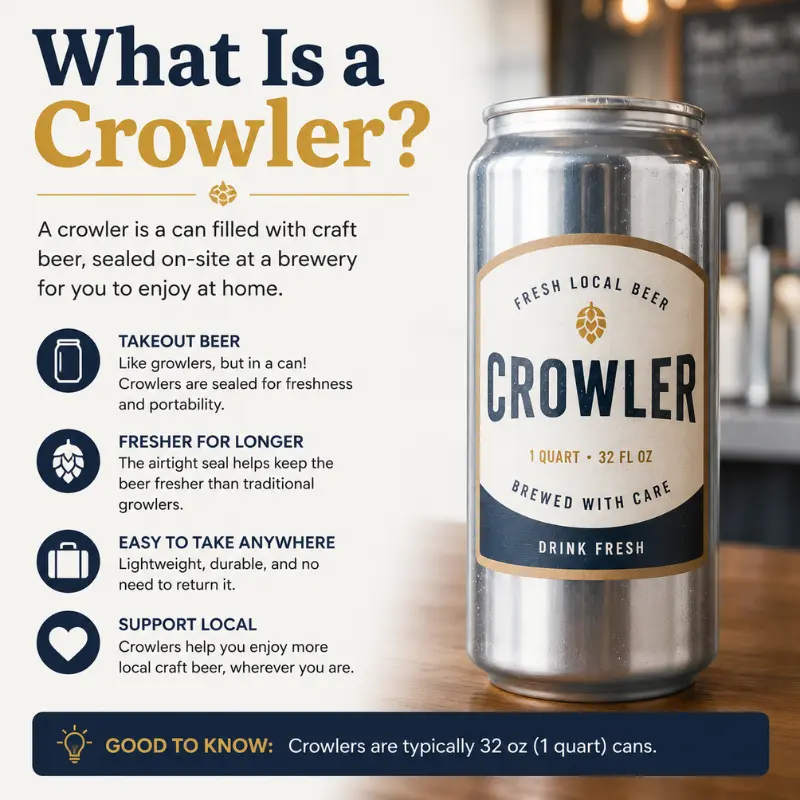
A crowler is a can designed to carry draft beer away from a brewery or taproom. Instead of purchasing a regular packaged beer, you can have beer poured directly from a draft tap into the can and then have the can sealed.
The word crowler is generally understood as a combination of “can” and “growler.” It combines the portability of a can with the concept of taking draft beer home in a growler-style container.
A crowler is usually made from aluminum. Once filled, it is sealed with equipment that creates a permanent can seam. Because the container is sealed, the beer is protected from additional exposure to air after filling.
One important point is that a crowler is not necessarily limited to exactly 32 ounces. Thirty-two ounces is the size many consumers associate with crowlers, but breweries and packaging suppliers may use other capacities.
What Is a Growler?
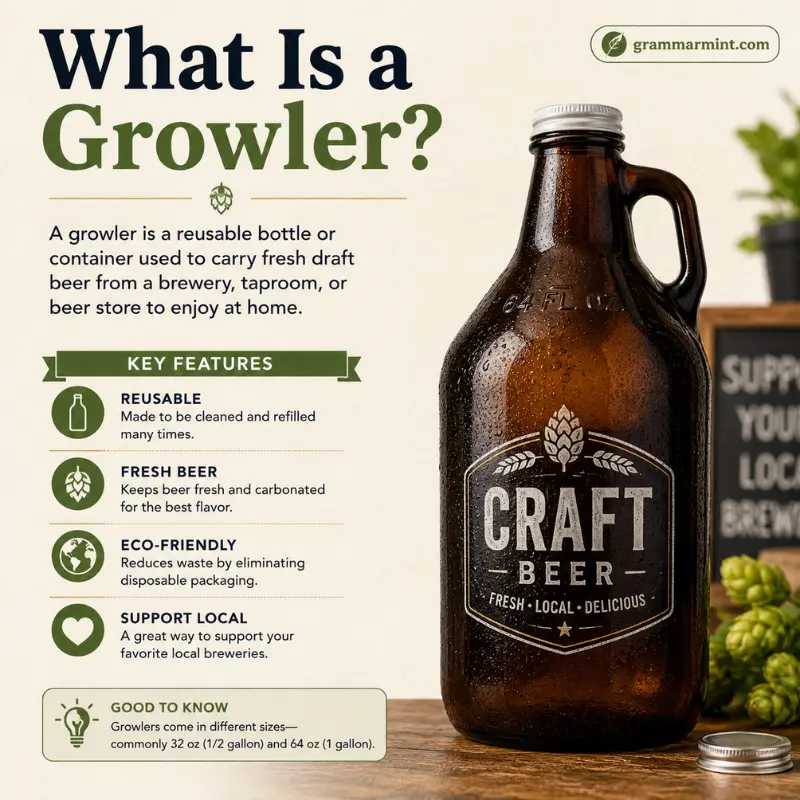
A growler is a reusable container designed for transporting draft beer. Traditional growlers are often made from glass and have a handle, although modern versions can be made from stainless steel, ceramic, or other materials.
The 64-ounce growler is one of the most familiar sizes in the United States. Since 64 ounces equals four 16-ounce pints, a full growler can provide several servings of beer.
Growlers are popular because they can be cleaned, stored, and taken back to a brewery for another fill, depending on the brewery’s policies. Some breweries refill their own growlers, while others may have rules about which containers they accept.
A growler can also be more practical when you want a larger amount of beer for a group.
Crowler vs. Growler: The Biggest Difference
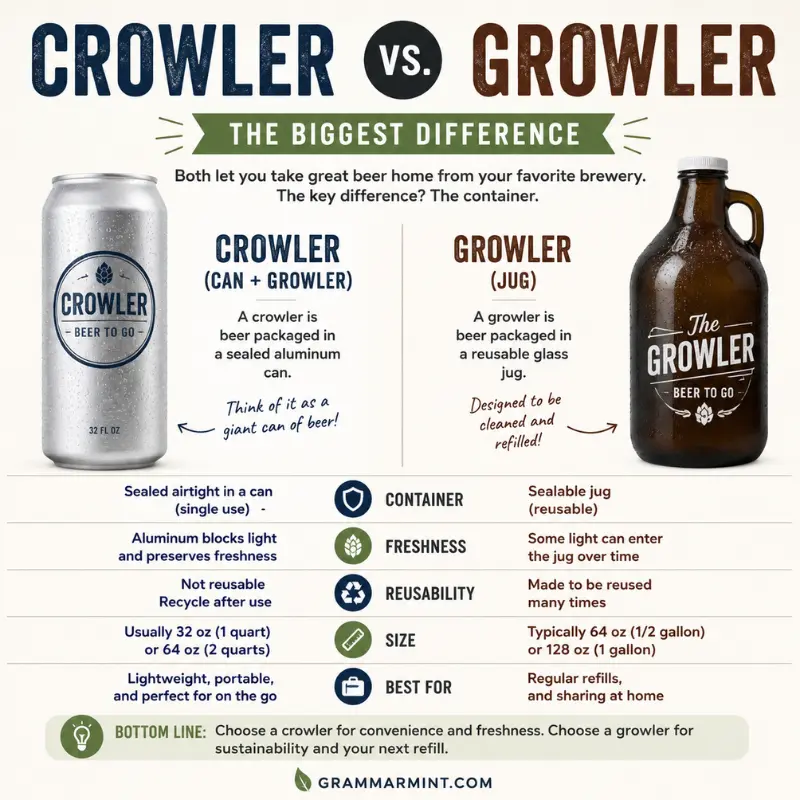
The easiest way to remember the difference is to focus on form and reuse.
A crowler is essentially a sealed beer can filled at the point of purchase. Once opened, you generally recycle the empty can rather than returning it for another fill.
A growler is a reusable beer container. You can wash it and potentially refill it many times.
For example:
“I picked up a crowler of IPA.”
This suggests that the beer came in a sealed can.
By contrast:
“I filled my growler with stout.”
This suggests a reusable container that was filled from a draft tap.
Why Would You Choose a Crowler?
Crowlers have several practical advantages.
Easy to Carry
Aluminum cans are relatively lightweight and easy to transport. This makes crowlers convenient for picnics, camping trips, outdoor gatherings, and other situations where carrying a glass container may be inconvenient.
Better Protection From Light
Aluminum blocks light, which can be useful because some beers can be negatively affected by exposure to light. A crowler therefore offers an advantage over a clear-glass growler when light protection matters.
Convenient for Short-Term Storage
A properly sealed crowler can protect beer from additional air exposure after it has been filled. However, it is still beer—not a product intended for indefinite storage. Freshness depends on the beer, filling process, storage conditions, and time.
Good for Limited-Release Beers
If a brewery releases a special IPA, stout, sour, or seasonal beer that is only available on draft, a crowler gives customers a convenient way to take it home.
Why Would You Choose a Growler?
Growlers also have several advantages.
Reusable
The biggest benefit is reusability. Instead of purchasing a new container every time, you can clean and refill a growler.
Larger Capacity
A 64-ounce growler holds twice as much beer as a 32-ounce crowler. That can make it a better choice for a gathering or when several people want to share the same beer.
Traditional Beer Experience
For many craft-beer fans, carrying a growler from a local brewery is part of the traditional draft-beer experience.
Useful for Regular Brewery Visits
If you frequently buy draft beer from the same brewery, a reusable growler can be practical. You can bring the container back, have it filled, and take it home again.
Crowler or Growler: Which Keeps Beer Fresher?
This question does not have a one-size-fits-all answer.
A properly sealed crowler generally has an advantage when it comes to limiting exposure to air after filling. Aluminum also protects the beer from light. These features can help preserve beer quality.
A growler, meanwhile, can lose carbonation more quickly, particularly after it is opened. Even before opening, the seal and filling method can affect how well the beer keeps its carbonation and freshness.
For the best quality, both types should generally be treated as fresh beer meant to be enjoyed relatively soon, rather than assuming that either container will preserve beer indefinitely.
Once a growler is opened, it is usually best to drink the beer promptly because opening the container allows carbon dioxide to escape and introduces oxygen.
How to Store a Crowler or Growler
Proper storage can help protect the quality of your beer.
Keep either container cold and away from direct sunlight. Refrigeration is especially important for maintaining beer quality.
For a crowler, avoid opening it until you are ready to drink the beer. Once opened, treat it like any other opened beer and consume it relatively soon.
For a growler, keep it refrigerated and upright when practical. After opening it, the beer is best enjoyed promptly because carbonation and freshness can decline.
Do not assume that a sealed container will make beer shelf-stable. Craft beer is generally best enjoyed according to the brewery’s recommended storage and consumption guidance.
Crowler vs. Growler for Outdoor Activities
If you are heading to a picnic, park, camping trip, or outdoor event, a crowler is often the more convenient option.
The aluminum container is lightweight, does not break like glass, and can be easier to pack. It also provides a sealed package that is convenient to transport.
A growler can still work for outdoor use, particularly stainless-steel versions, but glass growlers require more care because they are heavier and breakable.
For a long walk or hike, the lighter option is usually easier to carry.
Crowler vs. Growler for Parties
For a party, the choice depends on how much beer you need.
A 64-ounce growler may be ideal if several people want to share one beer. It provides a larger quantity and can be returned or reused later.
A 32-ounce crowler may be more convenient if you want several different beers rather than a large amount of one beer. For example, you could purchase three crowlers containing different styles: an IPA, a lager, and a stout.
This gives guests more variety without opening a large container of each beer.
Which Is More Environmentally Friendly?
Growlers have an obvious advantage in terms of reuse. A well-maintained growler can be washed and refilled repeatedly, reducing the need for a new container each time.
Crowlers, on the other hand, are generally intended for single use. However, aluminum is widely recyclable, so an empty crowler does not necessarily have to become landfill waste.
The environmental impact depends on several factors, including how often a growler is reused, how far it is transported, how it is cleaned, and whether aluminum containers are actually recycled in the local area.
Therefore, it is more accurate to say that reusable growlers can reduce packaging waste when they are used repeatedly, rather than claiming that every growler is automatically more environmentally friendly.
Origin of the Word Growler
The word growler has a long history in American beer culture. It has traditionally referred to a container used to carry draft beer from one location to another.
There are several stories about where the name came from. One popular explanation connects the word to the sound or “growling” noise made by beer or carbon dioxide escaping from an early container. However, the exact origin is not completely certain.
Modern growlers are much more sophisticated than historical beer containers, but the basic concept remains the same: take draft beer home in a portable container.
How the Word Crowler Was Created
The term crowler is much newer than growler. It is commonly explained as a blend of “can” and “growler.”
The idea was simple: create a container that combines the convenience of a can with the draft-beer filling experience associated with a growler.
Crowlers became increasingly popular as American craft breweries and taprooms expanded their draft-to-go options.
Unlike a traditional growler, a crowler does not depend on a reusable jug and cap. Instead, it is filled and then permanently sealed.
American English vs. British English
Both crowler and growler are strongly associated with American craft-beer culture.
There is not a standard British-American spelling difference such as color/colour or favorite/favourite. Instead, these are specialized beer terms whose familiarity depends largely on local beer culture.
In American English, you may see both words on brewery menus, taproom signs, beer blogs, and social media.
In other English-speaking countries, consumers may simply refer to beer being sold in cans, bottles, or other takeaway containers rather than using these specific terms.
Common Mistakes and Quick Fixes
Mistake 1: Calling Every Beer Container a Growler
Incorrect idea: Every container used to take draft beer home is a growler.
Better: A growler specifically refers to a reusable draft-beer container, while a crowler is a sealed can filled with draft beer.
Mistake 2: Saying Every Crowler Is Exactly 32 Ounces
Incorrect idea: A crowler must always be 32 ounces.
Better: Crowlers are commonly 32 ounces, but breweries may offer other sizes.
Mistake 3: Saying Every Growler Is 64 Ounces
Incorrect idea: Growler always means a 64-ounce jug.
Better: Sixty-four ounces is a common growler size, but growlers are available in different capacities.
Mistake 4: Saying Crowlers Are Refillable
Crowlers are generally designed as single-use cans. They are normally recycled rather than returned to a brewery for repeated filling.
Mistake 5: Saying Crowlers Keep Beer Fresh Forever
No beer container can guarantee indefinite freshness. A sealed crowler can help protect beer from oxygen and light, but storage conditions and the type of beer still matter.
Mistake 6: Confusing Crowler With Crawler
A crowler is a beer container.
A crawler is a completely different word. It can refer to something or someone that crawls, or appear in other unrelated contexts.
Everyday Examples
Casual Conversation
“I picked up a crowler of IPA from the brewery.”
Here, crowler means a sealed can of draft beer.
Social Media
“Growler fills are available Saturday—64 ounces of stout for game day!”
Here, growler refers to a larger reusable container.
Outdoor Trip
“Bring a couple of crowlers for the picnic. They’ll be easier to carry.”
The word crowler works because the speaker is referring to sealed aluminum cans.
Professional Writing
Instead of writing:
“We bought a growler.”
A more precise sentence could be:
“We bought a 64-ounce growler filled with draft beer.”
Or:
“We picked up a 32-ounce crowler of the brewery’s seasonal IPA.”
Specific wording helps readers immediately understand what type of container you mean.
Crowler or Growler: Which One Should You Buy?
The best choice depends on your needs.
Choose a crowler if you want:
- A lightweight container
- A sealed package
- Easy transportation
- Better protection from light
- A convenient option for outdoor activities
- A smaller amount of beer
- Several different beers in separate containers
Choose a growler if you want:
- A reusable container
- A larger quantity of beer
- Beer for several people
- A container you can refill
- A traditional draft-beer experience
- A practical option for frequent brewery visits
Crowler or Growler: Simple Memory Trick
If you frequently forget which word means which, use this simple trick:
Crowler = Can
The word crowler contains the idea of a can, and a crowler is a sealed can filled with draft beer.
Growler = Reusable Jug
A growler is the traditional larger container that you can bring back and refill.
You can remember it as:
This simple distinction will help you avoid most common mistakes.
Comparison Table
| Context | Best Choice | Why |
| One or two servings | Crowler | Compact and easy to carry |
| Outdoor recreation | Crowler | Lightweight and sealed |
| Sharing with a group | Growler | Larger capacity |
| Frequent brewery visits | Growler | Reusable and refillable |
| Protecting beer from light | Crowler | Aluminum blocks light |
| Reducing packaging through reuse | Growler | Can be refilled repeatedly |
| Trying several beers | Crowler | Easy to buy different beers |
| Traditional draft-beer experience | Growler | Classic reusable format |
| Gift or brewery souvenir | Growler | Reusable and collectible |
FAQs
What size is a crowler?
A crowler is commonly 32 ounces, although other sizes may be available depending on the brewery or packaging system.
What size is a growler?
A 64-ounce growler is one of the most common sizes in the United States, but growlers are available in several other sizes.
Can you reuse a crowler?
Crowlers are generally designed for single use. After the beer is consumed, the aluminum can can typically be recycled according to local recycling rules.
Can you refill a growler?
Yes. Growlers are designed to be reusable, although individual breweries may have specific rules about which containers they accept for refilling.
Which keeps beer fresher, a crowler or a growler?
A properly sealed crowler can have an advantage because it limits additional air exposure and blocks light. However, freshness depends on the beer, filling technique, storage conditions, and how long the beer is kept.
How long does beer last in a growler?
There is no single universal shelf-life for every growler. Once opened, beer generally loses carbonation and freshness relatively quickly, so it is best consumed promptly. Follow the brewery’s recommendations whenever available.
Are growlers environmentally friendly?
They can be. Their main environmental advantage is reusability. A growler that is repeatedly cleaned and refilled can reduce packaging waste compared with repeatedly purchasing single-use containers.
Is a crowler better than a growler?
Neither is universally better. A crowler is often better for portability, light protection, and short-term convenience, while a growler can be better for larger quantities, sharing, and repeated use.
Mini Quiz
1. Which container is commonly 32 ounces and sealed like a can?
Answer: Crowler
2. Which container is designed to be reused and refilled?
Answer: Growler
3. Which is often more convenient for a picnic or outdoor trip?
Answer: Crowler
4. Which is often a practical choice for sharing a larger quantity of beer?
Answer: Growler
5. Is every crowler exactly 32 ounces?
Answer: No. Thirty-two ounces is common, but other sizes can exist.
6. Is every growler exactly 64 ounces?
Answer: No. Sixty-four ounces is common, but other sizes are available.
Conclusion
When choosing between crowler or growler, remember that the two words describe different types of beer containers.
A crowler is a can filled with draft beer and sealed, commonly in a 32-ounce format. It is lightweight, portable, and offers good protection from light and additional air exposure after sealing.
A growler is a reusable container for draft beer, traditionally associated with glass jugs and commonly available in a 64-ounce size. It is especially useful when you want more beer, plan to share it, or regularly return to a brewery for refills.
The terms are not interchangeable, but the difference is easy to remember:
Crowler = sealed beer can.
Growler = reusable beer container.
Once you know that distinction, choosing the right word becomes simple. Whether you are ordering at a taproom, writing a beer guide, posting on social media, or chatting with friends, crowler and growler each have their own clear meaning.