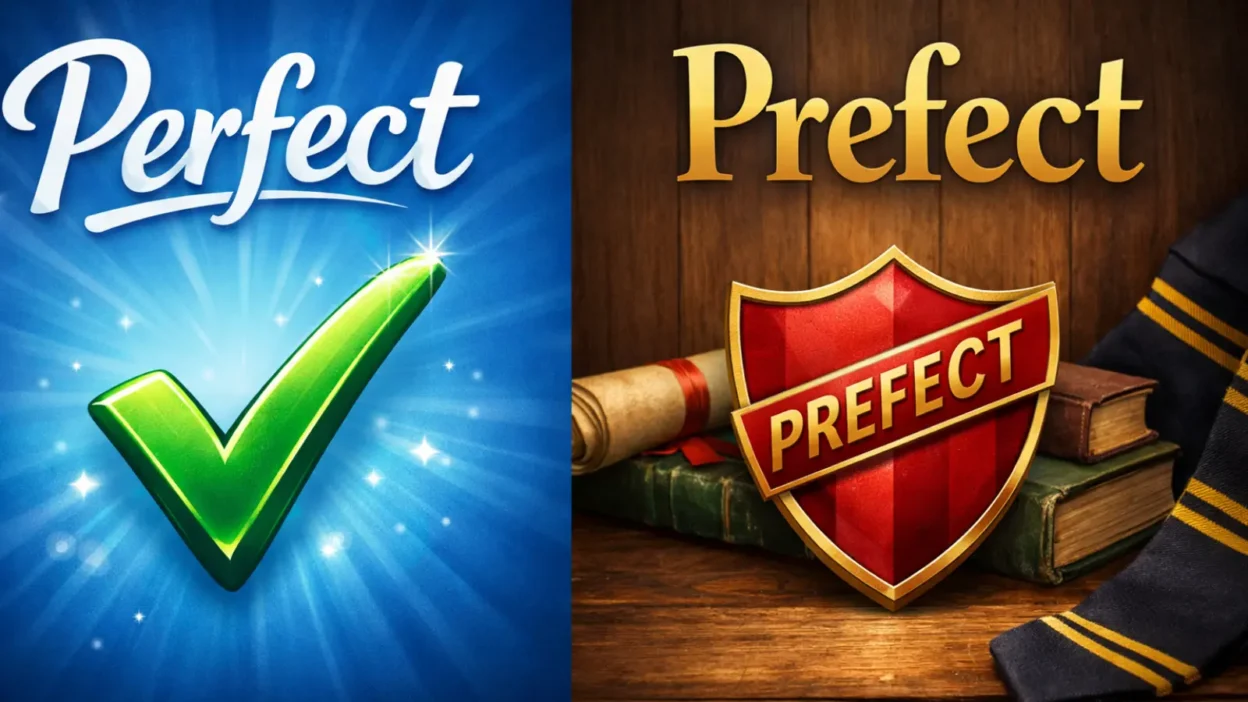
Many learners and even native speakers pause at the pair perfect vs. prefect. It’s easy to assume they mean the same thing because they look and sound very close. But in English, especially in the United States, these two words belong to completely different categories. One is a common adjective and verb you’ll see every day. The other is a specific noun you might only encounter in schools or historical contexts.
Why does this confusion matter? Choosing the wrong word can make writing look sloppy or unclear. In a school essay, a job email, or a casual message, using the correct term improves clarity and confidence. This guide walks you through how each word works, how they differ in tone and usage, and how to avoid common errors. By the end, you’ll be able to pick the right word and feel good about your choice.
Quick Answer
Perfect is the common, correct word in most contexts. It means “complete, without flaws” or describes a grammatical tense. Prefect is a noun referring to a student leader or official in certain school systems and some historical roles. Only one is correct when you mean “excellent” or “flawless.”
Key Differences at a Glance
Here’s a simple feature comparison to see how these words behave:
| Feature | Perfect | Prefect |
| Part of speech | Adjective and verb | Noun |
| Meaning | Flawless, complete, ideal | A leader or monitor (often in schools) |
| Common usage | Everyday English | Specialized term |
| US frequency | Very high | Low |
| Typical context | Grades, food, weather, performance | School roles, historical descriptions |
What Does Perfect Mean in English?
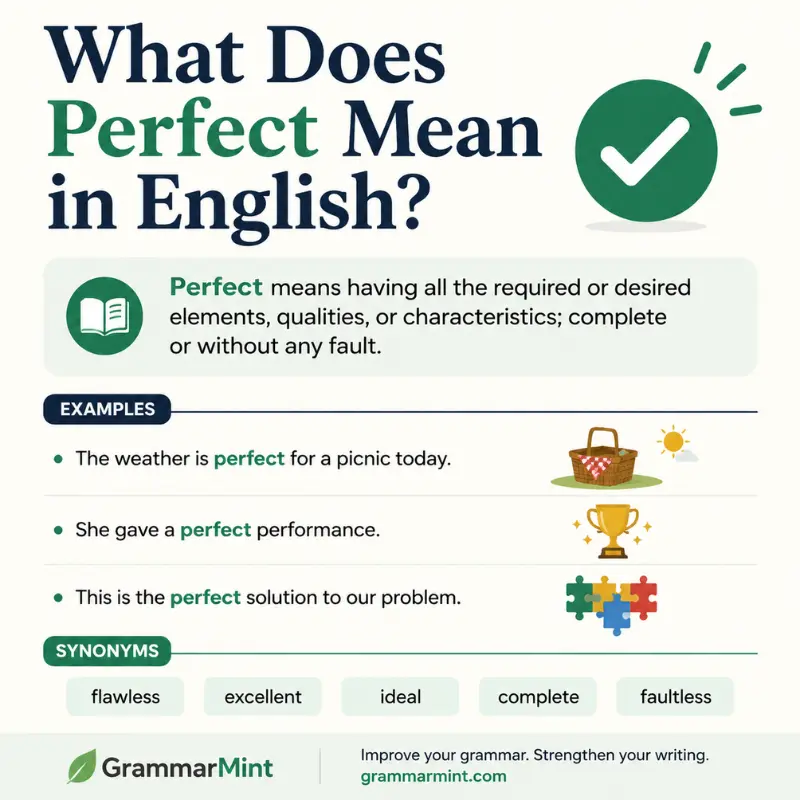
Perfect means something that is complete, correct, excellent, or without faults. It is one of the most common words in English and can describe people, objects, actions, situations, or results.
As an adjective, perfect describes something that meets the highest standard or has no noticeable problems.
Examples:
- The weather was perfect for a picnic.
- She gave a perfect answer during the interview.
- This recipe is perfect for beginners.
The word perfect can also describe something that is finished or complete, even if it does not mean “the best possible.”
Example:
- The timing was perfect for the meeting.
In grammar, perfect also refers to a verb form that shows a completed action, such as the present perfect, past perfect, and future perfect tenses.
Origin and Why Two Forms Exist
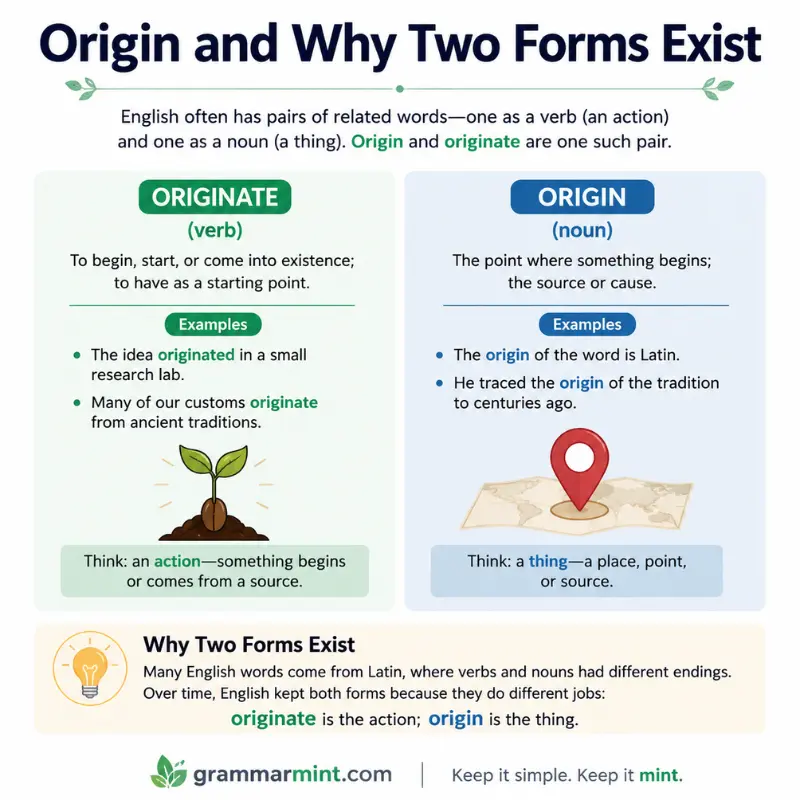
The root word for perfect goes back to Latin perfectus, meaning “completed.” Over time in English it came to describe something done well or without flaws. It also lent its name to a grammatical “perfect tense,” which shows actions that are completed.
Prefect comes from Latin praefectus, meaning “one placed in charge.” Historically, prefects were Roman officials with administrative duties. Today, in some countries like the UK and in older or private schools, a prefect is a student with responsibilities like helping maintain order. In the United States, the word isn’t common in everyday speech but is used in literature and in schools with British influence.
So although the spellings look alike, the similarity is historical and not semantic. One evolved into general English usage, while the other stayed tied to a specific role.
What Does Prefect Mean in English?
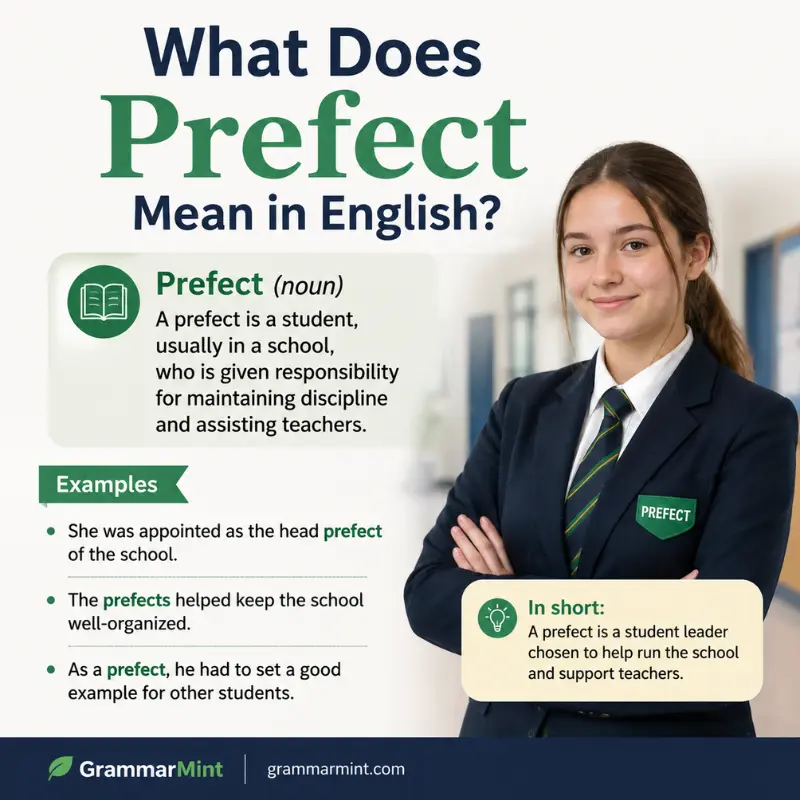
Prefect is a noun that refers to a person who has a position of authority or responsibility, especially in certain school systems.
In many British and Commonwealth schools, a prefect is a student chosen to help teachers maintain discipline, support younger students, or represent the school.
Examples:
- Sarah became a school prefect in her final year.
- The prefect helped organize the school event.
The word can also describe an official leader or administrator in historical contexts. For example, ancient Rome used the term prefect for certain government officials who managed specific areas or duties.
In modern American English, prefect is less common. Most US schools use terms like class president, student leader, or student council member instead.
Why Do People Confuse Perfect and Prefect?
People often confuse perfect and prefect because the two words look almost identical and have a similar pronunciation.
The difference is only one letter:
- Perfect → ends with -fect
- Prefect → ends with -fect, but has a different middle vowel sound
For English learners, this small spelling difference can easily cause mistakes, especially when writing quickly.
Another reason for confusion is that both words come from Latin roots and entered English hundreds of years ago. However, their meanings developed in completely different directions.
- Perfect became connected with ideas of completion and excellence.
- Prefect remained connected with leadership and authority.
Remember: perfect describes quality, while prefect describes a person or role.
British vs American English
There’s no real difference between British and American English for perfect — it’s universal. Prefect, on the other hand, appears more often in British and Commonwealth contexts, where some schools assign prefects among students. American schools rarely use the term, but you might see it in novels, historical texts, or descriptions of international schools.
In everyday US writing, perfect will almost always be the intended choice unless you are specifically referring to the title of a student leader or an official.
Perfect vs Prefect Pronunciation Explained
Although perfect and prefect are spelled similarly, they are usually pronounced differently.
Perfect:
Pronounced like:
PER-fekt
Example:
- “Your presentation was perfect.”
Prefect:
Pronounced like:
PREE-fekt (common British pronunciation)
Example:
- “The school prefect helped new students.”
The different vowel sounds help separate the meanings when spoken. However, because many learners focus on spelling rather than pronunciation, they may accidentally write prefect when they mean perfect.
A helpful trick:
- Perfect = perfection = excellent
- Prefect = person = leader
Which One Should You Use?
Everyday speech and writing:
Use perfect when you mean something is excellent, complete, finished, or without errors. For example, “That performance was perfect.”
Texts about schools or specific roles:
Use prefect only if you are describing a student leader or a specific title. For example, “The school prefect greeted visitors in the hall.”
Professional or academic writing:
Unless your topic is historical or educational systems that use the title, perfect is the right choice. Most readers will have little context for prefect and may mistake it for a typo.
If you need to avoid both for clarity in formal writing, phrases like “without flaws” or “student leader” can work depending on meaning.
Common Mistakes and Quick Fixes
• Mistake: “She did a prefect job on the project.”
Fix: Change prefect to perfect when you mean excellent work.
• Mistake: “I want everything to be prefect.”
Fix: Use perfect for complete without flaws.
• Mistake: “Our class prefect club meets today.” (in American context)
Fix: Clarify role or replace with “class leader” unless the title is officially used.
• Mistake: “Perfect your leadership role with prefect style.”
Fix: If you mean student leader, separate the ideas clearly: “Develop leadership skills like a school prefect.”
• Mistake: “The lesson on perfect was confusing.”
Fix: Specify whether you mean the adjective usage or the perfect tense: “The lesson on the perfect tense was confusing.”
• Mistake: “He is a prefect example of success.”
Fix: Use perfect to describe the example, not prefect.
Everyday Examples
Informal message/text:
• “Your cupcake recipe turned out perfect!”
• “Did you see the prefect on duty during assembly?” (if your school uses that title)
Social media:
• “Spent the perfect day at the beach.”
• “That school uses prefects instead of class presidents.”
Parenting/child context:
• “You made a perfect score on your spelling test!”
• “Ask the prefect in Grade 8 if you need help with lockers.” (only if your child’s school uses that term)
Workplace/email note:
• “The report is perfect for tomorrow’s meeting.”
• “If you meant student leader, you can say: ‘The student prefect will assist with orientation.’”
More professional rewrite:
• Casual: “The project looks perfect.”
Professional: “The completed project meets all the requirements.”
Usage and Trends (Qualitative)
Most people in the United States use perfect hundreds of times more often than prefect. Search engines, writing blogs, and dictionaries show perfect as a standard term for excellence or completeness. Prefect appears mainly in educational or historical contexts. Some learners only encounter the word prefect when reading British novels or descriptions of school systems outside the US.
Common discussion threads among English learners show that people often mistype perfect as prefect because of how similar they look and sound. Awareness of the distinct meanings can reduce errors.
Comparison Table
| Context | Best Choice | Why |
| Describing something flawless | perfect | It means complete and without errors. |
| Talking about a student leader role | prefect | It’s the official title in certain systems. |
| Grammatical tense | perfect | Refers to specific completed tense forms. |
| Casual praise (“great job!”) | perfect | Common everyday word. |
| Fiction set in British school | prefect | May reflect authentic context. |
| Professional email | perfect | Clear to all readers. |
Frequently Asked Questions
What’s the difference between perfect and prefect?
Perfect means something is complete or without flaws. Prefect is a specific noun for a leadership role in some schools or historical settings.
What does prefect mean?
A prefect is a student leader or monitor in some schools, particularly in British or international systems. It can also refer to certain historical officials.
Can prefect mean perfect?
No. They are separate words with different meanings. Prefect does not mean “flawless” or “complete.”
How do you use prefect in a sentence?
“She was chosen as the school prefect to help guide younger students.” Only use it when referring to the role.
What does perfect mean in grammar?
In grammar, perfect describes a tense showing completed actions, as in “has eaten” or “had finished.” It also means flawless in general usage.
Mini Quiz
- Choose the correct word: “That sunset was ___.”
Answer: perfect - Choose the correct word: “The ___ led the school assembly.”
Answer: prefect - Rewrite informally: “The essay was without any errors.”
Answer: The essay was perfect. - True or False: Prefect is commonly used in everyday American speech.
Answer: False - Fill in: “She has ___ her homework before dinner.”
Answer: perfected
Conclusion
In US English, perfect is the go-to word for describing something excellent, complete, or flawless.
Prefect is a niche noun tied to specific roles in certain school systems and historical settings.
Knowing the difference helps you write more clearly and avoid awkward mistakes.
When in doubt, think about meaning and audience: if you mean quality or completeness, choose perfect.
If you’re referring to a titled student or official, prefect is the right choice.