
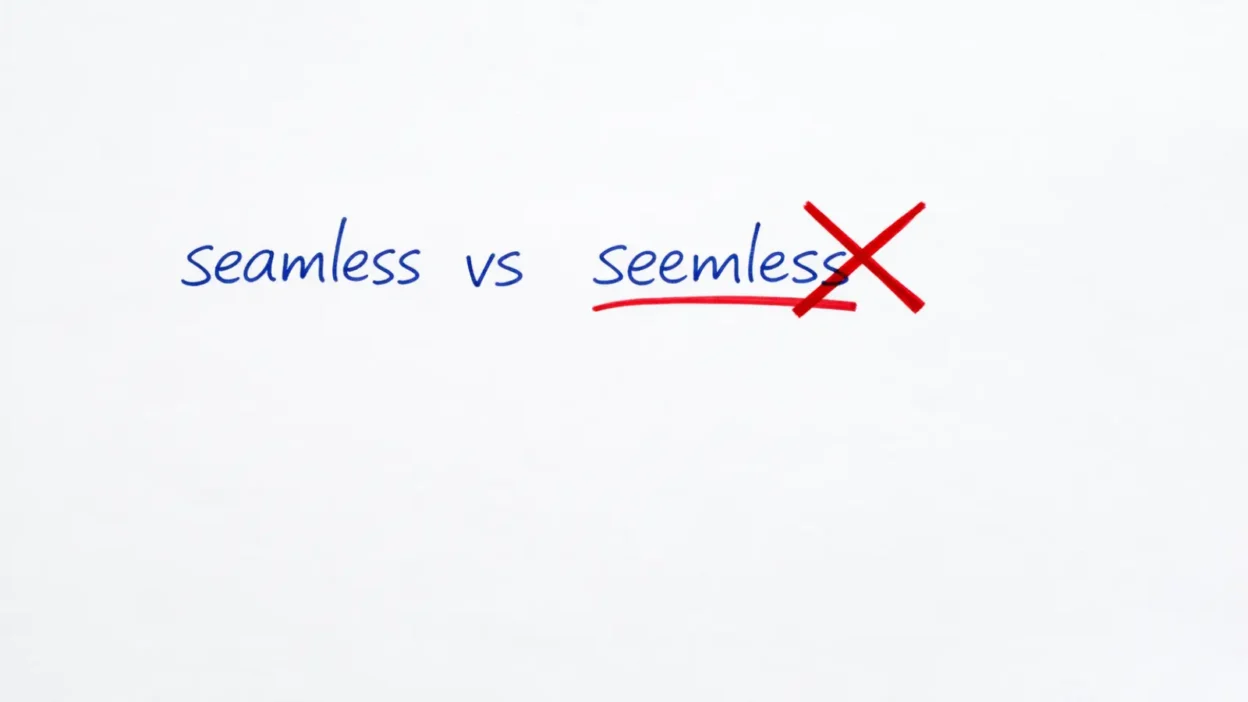
If you’ve ever paused while typing seemless and wondered whether it’s correct, you’re not alone.
Both words sound the same when spoken, and that similarity leads many people to confuse how they’re spelled in English.
In the United States and other major English-speaking regions, there’s a clear standard: one form is correct, and the other isn’t accepted in modern English.
This article will answer the question upfront, explain why one form is right and the other is wrong, show real examples, and give clear tips so you can avoid this common mistake in your emails, reports, and everyday writing.
Quick Answer
“Seamless” is the correct spelling.
“Seemless” is a misspelling or obsolete form that should be avoided. Dictionaries such as Merriam-Webster and Cambridge list seamless as an adjective meaning “without seams” or “smooth and continuous.”
There is no accepted modern meaning of seemless in standard English.
Key Differences at a Glance
• Seamless
– Correct, standard spelling in US English.
– Means “smooth, continuous, without seams.”
– Used in professional and informal contexts.
• Seemless
– Incorrect spelling of seamless in modern English.
– Sometimes listed as obsolete meaning “unseemly,” but not used in today’s writing.
– Should be avoided.
Why Two Forms Exist
The correct word seamless is formed from seam (the line where two pieces of fabric are joined) plus the suffix -less (meaning “without”). That gives a clear meaning of “without seams” or figuratively “smooth and uninterrupted.”
The variant seemless may come from speakers confusing the sound of seam with the unrelated verb seem. Because English has many irregular spellings, some learners guess seemless, but it isn’t recognized in modern dictionaries as a valid alternate form.
What Does “Seamless” Mean?

The adjective seamless has both a literal and a figurative meaning. Originally, it described something made without visible seams or joins. A seamless piece of clothing, for example, may be constructed without the noticeable stitched lines found in traditional garments.
Today, however, the figurative meaning is extremely common. When people describe an experience, process, transition, or service as seamless, they usually mean that it happens smoothly and without obvious interruptions, problems, or delays.
For example:
• The company promises a seamless shopping experience.
• The new software allows seamless communication between departments.
• The movie made a seamless transition from comedy to drama.
• Her presentation moved seamlessly from one topic to the next.
In these examples, there are no physical seams. Instead, the word suggests that separate parts connect so smoothly that the transition between them is barely noticeable.
This figurative use explains why seamless appears frequently in business, technology, marketing, design, customer service, and everyday communication.
Literal vs Figurative Meaning of “Seamless”
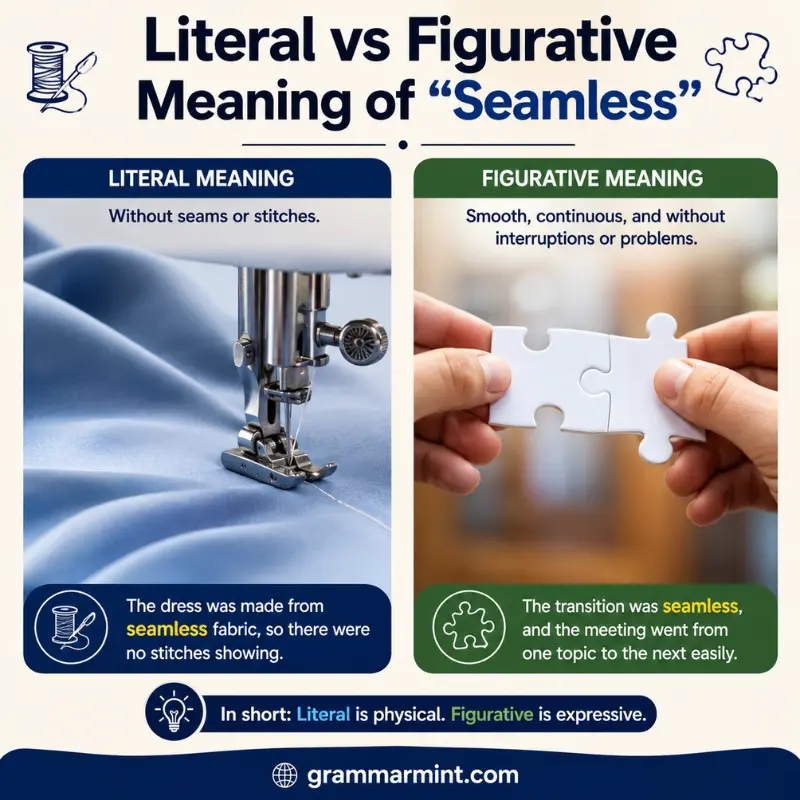
Understanding the two main meanings of seamless can make the spelling easier to remember.
Literal Meaning
In its literal sense, seamless means having no seams or visible joins.
Examples include:
• seamless clothing
• seamless pipes
• seamless flooring
• seamless wallpaper
• seamless fabric
• seamless metal tubing
Here, the connection to the noun seam is easy to see. If something has no seam, it is seam-less.
Figurative Meaning
Figuratively, seamless describes something smooth, continuous, or well integrated.
For example:
“The transfer from the old system to the new one was seamless.”
This does not mean that a computer system literally contains seams. Instead, it means that the change occurred without major interruptions or noticeable difficulties.
Similarly:
“The hotel offers a seamless booking experience.”
The sentence means customers can move through the booking process easily, without confusing steps or unnecessary obstacles.
Remembering the literal meaning can help you spell the figurative meaning correctly as well.
Why Is “Seemless” Such a Common Misspelling?
One major reason for the mistake is pronunciation. In most forms of English, seam and seem are homophones. They sound the same even though their spellings and meanings are different.
Compare:
Seam: a line where two pieces of material are joined.
Seem: to appear or give a particular impression.
Consider these sentences:
“The seam on my jacket is coming apart.”
“You seem tired today.”
Because both words sound alike, someone hearing seamless in conversation may incorrectly imagine that the word begins with seem. This is especially easy to do if the person knows the figurative meaning of seamless but has never connected it to a physical seam.
The suffix -less can also make the mistake appear logical at first. English contains many words formed by adding -less to another word:
• careless = without care
• harmless = without harm
• hopeless = without hope
• endless = without end
• fearless = without fear
• seamless = without seams
However, seemless would theoretically mean “without seeming,” which does not describe the modern meaning people intend.
Thinking about the construction of the word is therefore one of the easiest ways to avoid the spelling error.
British vs American English
There is no spelling difference between British and American English here. Seamless is the correct form in both, and seemless is incorrect in all standard variants of English. Some historical sources list an archaic meaning for seemless, but that isn’t part of current language use.
How “Seamless” Is Used in Modern American English
In modern US English, seamless appears in many different fields. Although its basic meaning stays the same, the exact idea it communicates depends on the context.
Technology
Technology companies often use seamless to describe software, devices, integrations, and digital experiences that work smoothly together.
For example:
“The platform provides seamless integration with popular payment services.”
Here, seamless suggests that users can connect different systems without complicated steps or disruptive technical problems.
Business
In business communication, seamless often describes transitions, operations, customer experiences, and teamwork.
For example:
“We want to ensure a seamless transition after the management change.”
The phrase indicates that the company wants the change to happen without disrupting normal operations.
Customer Service
Businesses may promise a seamless customer experience when they want customers to move easily between browsing, purchasing, payment, support, and delivery.
For example:
“Our new website creates a seamless experience from checkout to delivery tracking.”
Fashion
In clothing, seamless may retain its literal meaning.
For example:
“She bought seamless leggings for her workout.”
In this context, the garment may have few or no noticeable seams, which can improve comfort or create a smoother appearance.
Design
Designers may describe backgrounds, patterns, flooring, or visual elements as seamless when individual sections connect without visible breaks.
A seamless pattern, for instance, can repeat continuously without showing obvious edges between repetitions.
When to Use “Seamless”
The app provides a seamless checkout process.
• There was a seamless transition between the two scenes.
• Our team created a seamless customer experience.
Seamless as an Adjective
Seamless is primarily an adjective, which means it modifies a noun.
Common combinations include:
• seamless experience
• seamless transition
• seamless integration
• seamless process
• seamless design
• seamless connection
• seamless service
• seamless transfer
• seamless workflow
• seamless journey
For example:
“The developers created a seamless integration between the two applications.”
Here, seamless describes the noun integration.
Another example is:
“The staff provided a seamless experience for every guest.”
Again, the adjective tells us what kind of experience the guests received.
Because seamless is an adjective, it usually appears directly before a noun or after a linking verb such as be, feel, look, or become.
For example:
“The transition was seamless.”
“The entire process felt seamless.”
Both constructions are grammatically correct.
Seamless vs Seamlessly
Although seamless and seamlessly are closely related, they play different grammatical roles.
Seamless is an adjective.
“The company created a seamless payment process.”
Seamlessly is an adverb.
“The payment system works seamlessly.”
The adjective describes a person, thing, experience, or process. The adverb usually describes how an action happens.
Compare:
“The integration was seamless.”
“The two systems integrated seamlessly.”
Both sentences communicate a similar idea, but the grammar is different.
A useful shortcut is to ask what you are describing. If you are describing a noun, seamless will often be the right form. If you are describing how an action happens, seamlessly may be more appropriate.
Common Synonyms for “Seamless”
Depending on the sentence, several words can express a similar idea to seamless.
Possible synonyms include:
• smooth
• continuous
• uninterrupted
• effortless
• integrated
• flawless
• fluid
• consistent
• unbroken
• trouble-free
However, these words are not always perfect replacements.
For example, a seamless transition and a smooth transition have almost the same meaning. By contrast, seamless clothing cannot always be replaced naturally with smooth clothing because the literal absence of seams may be important.
Context therefore determines the best synonym.
A business might say:
“We provide a seamless customer experience.”
A simpler alternative would be:
“We provide a smooth customer experience.”
Both work, although seamless often emphasizes that the customer can move between different stages without noticing interruptions.
Common Mistakes (and Quick Fixes)
• Mistake: writing “seemless transition.”
Fix: write “seamless transition.”
• Mistake: proofreading missed “seemless” because it sounds right.
Fix: remember the base word is seam, not seem.
• Mistake: thinking seemless is acceptable in casual text.
Fix: treat it as a spelling error in both casual and formal writing.
• Mistake: using autocorrect suggestions blindly.
Fix: double-check uncommon words before hitting send.
How to Remember the Correct Spelling
A simple memory trick is to break the word into two parts:
seam + less = seamless
Imagine a shirt, pipe, floor, or piece of fabric with no visible seam. It is literally seam-less.
You can also remember this sentence:
If there is no seam, it is seamless.
The verb seem has nothing to do with the meaning.
Another useful trick is to associate the word with a common phrase such as seamless transition. Once you remember that a transition joins two stages together like a seam joins two pieces of material, the spelling becomes easier to recall.
Writers who frequently confuse homophones may also benefit from checking the base word before adding a suffix. Doing so can prevent similar spelling errors elsewhere in English.
More Examples of “Seamless” in Sentences
Here are additional examples showing how seamless works naturally in different situations:
- The update created a seamless experience across mobile and desktop devices.
- The actors made the scene change look completely seamless.
- We need a seamless transition between the planning and production stages.
- The designer created a seamless pattern for the website background.
- Travelers appreciated the airline’s seamless check-in process.
- The two departments worked together to provide seamless support.
- The renovation created a seamless connection between the kitchen and living room.
- Her speech made a seamless shift from serious discussion to humor.
- Cloud synchronization allows a seamless experience across multiple devices.
- The new payment system makes online shopping feel almost seamless.
Each example carries the same central idea: separate elements connect or function together without an obvious interruption.
Everyday Examples
Texting / Chat:
• “That edit looks seamless!”
• (Incorrect) “That edit looks seemless!”
Social Media:
• “The concert’s setlist was arranged in a seamless flow.”
• (Incorrect) “The concert’s setlist was seemless.”
Work Email:
• “Let’s aim for a seamless handoff between shifts.”
Professional rewrite: “Please ensure a seamless transition in tomorrow’s shift change.”
Comparison Table
| Context | Best Choice | Why |
|---|---|---|
| Formal writing | seamless | Standard, accepted spelling in dictionaries |
| Everyday texting | seamless | Clear and widely understood |
| Design/fashion | seamless | Correct term for smooth or joinless items |
| Presentations | seamless | Professional and polished |
| Academic writing | seamless | Only correct form recognized |
FAQs
Is it seamless or seemless?
Seamless is the correct spelling in modern English. Seemless is generally considered a misspelling and should be avoided in both formal and informal writing.
What does seamless mean?
Seamless means without visible seams or, figuratively, smooth and uninterrupted. For example, “The company provided a seamless checkout experience.”
Is seemless a real word?
Seemless has appeared historically in obsolete usage, but it is not the accepted spelling when you mean smooth, continuous, or without seams. Use seamless in modern English.
Why do people write seemless instead of seamless?
People often confuse the spellings because seam and seem sound the same. However, seamless comes from seam + less, meaning “without seams.”
Is seamless correct in American English?
Yes. Seamless is the standard spelling in American English as well as British English. There is no US–UK spelling difference for this word.
What is the difference between seamless and seamlessly?
Seamless is an adjective, while seamlessly is an adverb. For example, “It was a seamless transition” and “The systems worked seamlessly together.”
How can I remember the spelling of seamless?
Think of the word as seam + less. Something without a seam is seamless. Connecting the spelling to the noun seam makes it easier to remember.
Mini Quiz
- Which is correct: seamless or seemless? — seamless
- The event moved __________ from start to finish. — seamlessly
- True or false: seemless is acceptable in US academic papers. — False
Conclusion
You now know that seamless is the correct spelling in American English and that seemless is an incorrect variant that should be avoided.
In all contexts — casual texts, business communication, and formal writing — choosing seamless helps your writing look polished and professional.
Next time you’re unsure, think “seam + less” and you’ll spell it right every time.