Have you ever wondered whether the correct spelling is feel or feal? These two words look similar and sound alike, but they have different meanings and uses. The correct choice depends on what you want to express.
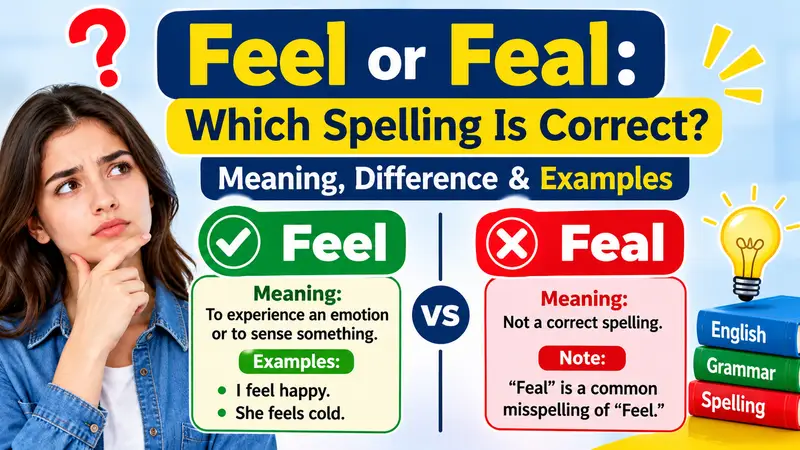
Feel is the correct spelling for ordinary modern English when talking about emotions, physical sensations, touch, or opinions. For example, you should write, “I feel happy today,” not “I feal happy today.
However, feal is also a real English word. It is an archaic adjective meaning “faithful” or “loyal.” It is rarely used in everyday American English.
In this guide, you’ll learn the meanings of both words, their differences, correct examples, and simple ways to remember which spelling to use.
Feel or Feal: Which Is Correct?
Feel is the correct word for almost all everyday modern English situations. It is a common verb used to describe emotions, physical sensations, touch, and personal opinions.
Feal is an actual dictionary word, but it has a different and much less common meaning. It is an archaic adjective that describes someone who is faithful, loyal, or trustworthy.
Here is the basic difference:
| Word | Meaning | Usage |
|---|---|---|
| Feel | To experience a sensation or emotion | Common modern English |
| Feal | Faithful or loyal | Archaic and rarely used |
Examples:
- Correct: I feel tired after working all day.
- Incorrect: I feal tired after working all day.
- Historical usage: The knight remained feal to his king.
If you are writing a text message, school assignment, email, or everyday conversation, choose feel.
What Does Feel Mean?
The word feel is a common English verb that describes experiencing something through your senses, emotions, or thoughts.
It can refer to physical sensations, emotional experiences, touching objects, or personal opinions.
According to standard dictionary definitions, feel has several meanings depending on the context.
1. To Experience an Emotion
Feel is frequently used to describe emotional experiences such as happiness, sadness, excitement, anger, or nervousness.
Examples:
- I feel happy when I spend time with my family.
- She feels nervous before every examination.
- They feel excited about their upcoming vacation.
- He felt disappointed after losing the competition.
2. To Experience a Physical Sensation
Feel can also describe physical experiences, including pain, warmth, coldness, and discomfort.
Examples:
- I feel cold in this room.
- She feels pain in her shoulder.
- Do you feel better today?
- My hands feel warm after holding the cup.
3. To Touch or Examine Something
Another meaning of feel is to touch something to understand its texture, shape, temperature, or condition.
Examples:
- Feel this soft blanket.
- She felt the fabric before buying the dress.
- I touched the wall to feel its texture.
- He felt the surface to check whether it was smooth.
4. To Have an Opinion or Belief
Feel can also express someone’s personal opinion, impression, or belief about a situation.
Examples:
- I feel that we should leave early.
- She feels the decision was unfair.
- We feel confident about our plans.
- He feels that education is important.
What Does Feal Mean?
Feal is an uncommon, archaic English adjective meaning faithful, loyal, or true to someone.
It is not a modern alternative spelling of feel. The word has historical roots and is associated with older English and Scottish usage.
Dictionary.com identifies feal as an archaic word meaning faithful or loyal. Collins also records it as an archaic adjective.
Examples of historical-style usage include:
- The servant remained feal to his master.
- The knight was known as a feal companion.
- She considered him a feal and trustworthy friend.
These examples demonstrate the historical meaning rather than normal contemporary conversation.
You are unlikely to encounter feal in everyday American writing. If you see it in an older book, historical document, or literary passage, its meaning may be related to loyalty or faithfulness.
Feel vs. Feal: Key Differences
Although feel and feal share the same pronunciation in standard dictionary descriptions, their meanings, grammatical roles, and frequency of use are different.
Here are the main differences:
| Comparison | Feel | Feal |
|---|---|---|
| Part of speech | Verb and noun | Adjective |
| Meaning | Experience, sense, touch, or emotion | Faithful or loyal |
| Modern usage | Very common | Extremely rare |
| Tone | Everyday and conversational | Historical or literary |
| American English | Standard word | Archaic word |
| Example | I feel happy. | A feal companion. |
Are Feel and Feal Homophones?
Yes, they are generally treated as homophones because they share the same pronunciation in English.
A homophone is a word that sounds like another word but has a different spelling or meaning.
Other familiar examples include:
- Sea and see
- Right and write
- Their and there
- Flour and flower
- Feel and feal
Because feel and feal sound alike, people may confuse their spellings when writing.
However, their meanings are not interchangeable.
Feel or Feal in Example Sentences
Understanding words becomes easier when you see how they work in everyday sentences.
Here are examples showing the correct use of feel and the historical meaning of feal.
Correct Examples Using Feel
Example 1: I feel much better after getting enough sleep.
Example 2: How do you feel about your new job?
Example 3: This sweater feels incredibly soft.
Example 4: She felt nervous before her interview.
Example 5: We feel grateful for your support.
Example 6: He can feel the cold wind outside.
Example 7: I feel that this is the right decision.
Example 8: The baby feels sleepy after drinking milk.
Examples of Feal in Historical Context
Example 1: The knight remained feal to his king.
Example 2: He was remembered as a feal and loyal companion.
Example 3: The ruler trusted his feal servants.
These examples illustrate the older meaning of feal. They are not recommended as everyday modern English expressions.
Incorrect vs. Correct Sentences
| Incorrect spelling | Correct spelling |
|---|---|
| I feal happy today. | I feel happy today. |
| How do you feal? | How do you feel? |
| She feals excited. | She feels excited. |
| I fealed sick yesterday. | I felt sick yesterday. |
| They feal confident. | They feel confident. |
| He is fealing better. | He is feeling better. |
Remember that feal should only be used when you specifically intend its rare historical meaning.
What Are the Different Forms of Feel?
One important reason to learn the spelling of feel is that it is an irregular verb.
Unlike regular verbs that commonly form their past tense by adding “-ed,” feel changes its spelling.
Here are its main grammatical forms:
| Verb form | Correct spelling | Example |
|---|---|---|
| Base form | Feel | I feel happy. |
| Third-person singular | Feels | She feels better. |
| Past tense | Felt | I felt tired. |
| Past participle | Felt | I have felt this before. |
| Present participle | Feeling | He is feeling great. |
Why Is Fealed Incorrect?
A common spelling mistake is writing fealed as the past tense of feel.
However, feel is an irregular verb, so its past tense is felt, not fealed.
- Yesterday, I felt happy.
- She felt nervous during the presentation.
- We have felt this emotion before.
- He is feeling much better now.
Learning these forms will help you avoid common grammar and spelling mistakes.
Common Mistakes When Using Feel and Feal
Even though the difference is straightforward, writers sometimes confuse these words because they sound alike.
Here are some mistakes to avoid.
1. Writing Feal Instead of Feel
The most common mistake is using feal when describing emotions or physical sensations.
Incorrect: I feal excited about my birthday.
Correct: I feel excited about my birthday.
2. Using Fealed as the Past Tense
Feel does not follow the regular “-ed” pattern.
Incorrect: She fealed sad yesterday.
Correct: She felt sad yesterday.
3. Thinking Feal Is Another Spelling of Feel
Feal is a real word, but it has a separate historical meaning.
It does not replace feel in modern everyday sentences.
4. Forgetting the Double E
The word feel contains two consecutive letter E’s.
Incorrect: Fel
Incorrect: Feal
Correct: Feel
Remembering the double E can help you spell the common verb correctly.
How to Remember Whether to Use Feel or Feal
If you regularly confuse these spellings, a few simple techniques can help.
1. Remember the double E: The everyday verb is spelled F-E-E-L.
2. Connect it with emotions: If you are talking about how you feel, use feel.
3. Remember the past tense: Feel changes to felt, not fealed.
4. Think about everyday conversations: Expressions such as “I feel good,” “I feel tired,” and “How do you feel?” always use feel.
5. Reserve feal for historical writing: Unless you are discussing its archaic meaning of faithful or loyal, you probably do not need to use it.
FAQs
Feel is the correct spelling for everyday modern English when describing emotions, sensations, touch, or opinions. Feal is an archaic adjective meaning faithful or loyal.
Yes. Feal is a real but rarely used English word. It is classified as an archaic adjective meaning faithful or loyal. It is not a modern alternative to feel.
Feel means to experience an emotion or physical sensation, perceive something through touch, or have an opinion about something. For example, “I feel happy today.”
The past tense of feel is felt. Its past participle is also felt. For example, “I felt tired yesterday” and “I have felt this way before.”
Yes, they are generally pronounced the same, like the word “wheel” without the initial W. However, their spellings and meanings are different.
No. Feel is the standard spelling in both American and British English. Feal is a separate archaic word, not a regional spelling variation.
You can use feel to describe an emotion, sensation, or opinion. For example: “I feel excited about my new opportunity.” It can also describe touch, as in “This fabric feels soft.”
People confuse these words because they look similar and share the same pronunciation. However, remembering that feel is the common modern verb and feal is an archaic adjective makes the difference easier to understand.
Conclusion
When choosing between feel or feal, the correct spelling for everyday modern English is almost always feel. Use it when describing emotions, physical sensations, touch, or personal opinions.
Feal is also a legitimate English word, but it is an archaic adjective meaning faithful or loyal. It is rarely used in contemporary American English.
The easiest way to remember the difference is simple: feel is the word you need for everyday communication, while feal belongs mainly to historical or literary contexts.
Keep practicing with the examples in this guide, and you will find it easier to avoid this common spelling mistake. Explore more spelling comparisons and English usage guides to improve your everyday writing.
SEO Details
Primary keyword: feel or feal
Secondary keywords:
- feel vs feal
- feal or feel
- feel meaning
- feal meaning
- correct spelling of feel
- is feal a word
- feel spelling
- feal definition
Long-tail keywords:
- is it feel or feal which is correct
- what is the difference between feel and feal
- how do you spell feel correctly
- what does feal mean in English
- is feal the British spelling of feel
- what is the past tense of feel
SEO Meta Title (under 60 characters):
Feel or Feal: Which Spelling Is Correct?
Meta Description (under 155 characters):
Feel or feal: Discover the correct spelling, meanings, differences, and examples to avoid common English spelling mistakes.
URL Slug:
feel-or-feal
Suggested category: Grammar & Spelling